By tsumo Editorial. Published 2026-05-04. 8 minute read.
A deep dive into the hidden machinery, magnetic belts, and the 1970s Japanese Jantaku boom that revolutionized the speed and economy of modern Mahjong.
For traditionalists, the physical "washing" of Mahjong tiles—the loud, chaotic clattering of bone or plastic across felt—is the heartbeat of the game. But for modern players, parlor owners, and professionals, the real heartbeat of Mahjong is a quiet, rhythmic hum emanating from beneath the table.
The automatic Mahjong table is a marvel of niche engineering. It takes one of the most mechanically tedious parts of the game (shuffling, building walls, and dealing 136 or 144 tiles) and automates it flawlessly in seconds. But how does the table know which side of the tile is face-up? How does it build four perfect walls without jamming? And why did this incredibly specific piece of machinery explode in popularity?
The Magnetic Secret
The magic of an automatic Mahjong table doesn't just lie in the table itself—it lies in the tiles.
Standard Mahjong tiles are solid, but tiles built for automatic tables contain a hidden, heavily polarized magnet embedded just beneath the blank back surface. This off-center weighting and precise magnetic polarity are the keys to the entire sorting mechanism.
The Washing Ring and Conveyor Belts
When a hand ends and a player pushes the center button, the central hub drops down, and the players push the discarded tiles into the abyss. Underneath the felt is a large, spinning, bowl-shaped disc lined with felt or soft plastic. This is the "washing ring."
As the ring spins, it throws the tiles outward toward a magnetized conveyor belt. Because the tiles are polarized on one side, they will only adhere to the magnetic belt if they are face-up (meaning the blank back is touching the belt). If a tile approaches the belt face-down, the magnets repel it, and it tumbles back into the washing ring until it flips over.
Once secured to the belt, the tiles travel up an elevator mechanism and are pushed horizontally to form the walls. Internal optical sensors count the exact number of tiles required for the specific variant being played (e.g., 34 tiles per wall for 136-tile Japanese Riichi). Once all four walls are built, hydraulic lifts raise them seamlessly onto the table surface.
Zero Downtime: The Twin-Set System
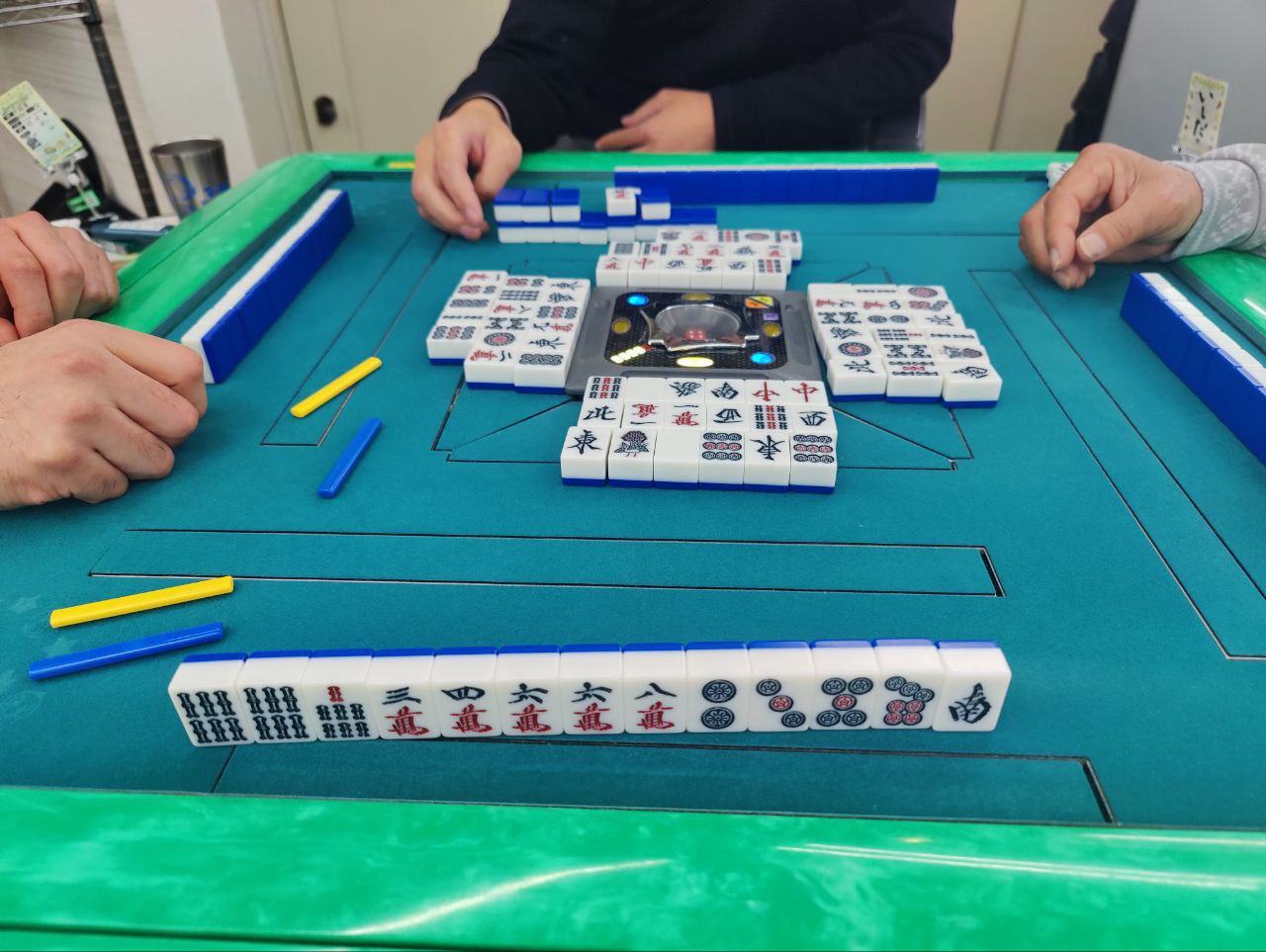
Perhaps the most brilliant aspect of the automatic table is that it uses *two* sets of tiles simultaneously—usually one with blue backs and one with yellow backs.
While players are actively drawing and discarding the blue tiles on the table surface, the machine is busy underneath sorting and building the walls for the yellow tiles. The moment the current hand ends and the blue tiles are pushed into the center, the pre-built yellow walls rise up instantly. This twin-set system completely eliminates downtime, keeping the players in a continuous state of flow.
The Jantaku Boom of the 1970s
The automatic Mahjong table (known in Japan as the *Jantaku*) was not born out of sheer convenience; it was born out of ruthless economic efficiency.
In the late 1970s and 1980s, Japan experienced a massive Mahjong boom. Parlors (jansou) were packed with salarymen playing Riichi Mahjong. Parlor owners charged players by the hour. However, manually shuffling tiles and building walls takes roughly two to three minutes per hand. Over the course of an hour, that equates to significant lost revenue.
The invention of the automatic table changed the economics of Mahjong overnight. By eliminating the shuffling downtime, parlors could squeeze 20-30% more hands into a single hour. Companies like Taiyo Chemicals (who manufacture the famous *Amos* tables) rapidly innovated, adding features like automatic dice rolling and electronic point-display drawers. The Jantaku transformed Mahjong from a leisurely parlor game into a high-speed, hyper-efficient battle.
Modern Innovations: RFID and Beyond
Today, automatic tables are more advanced than ever. High-end models, particularly those used in professional Japanese leagues like the M.League, feature RFID chips embedded directly into the scoring sticks (tenbou). The table instantly reads the chips inside the player's drawer and displays the exact score on a digital screen, eliminating the need to manually count points.
Meanwhile, modern Chinese tables have innovated even further to support variants that don't use standard walls. Some tables now feature a central dealing mechanism that automatically sorts and deals the starting hand directly to each player via four motorized slots, ensuring lightning-fast starts.
The automatic Mahjong table represents a perfect marriage of cultural tradition and modern engineering. By handling the tedious mechanics of the shuffle, it allows players to focus entirely on the psychology, strategy, and thrill of the game.
Sources and Further Reading
How This Connects to Practice
This editorial piece is part of the same public learning system as the rules guides, tutorial routes, puzzles, and club locator. Use the article for context, then use the linked tsumo guides or practice routes to test the same ideas in concrete Mahjong decisions.
Editorial Notes for Players
For The Engineering Marvel of Automatic Mahjong Tables, the useful takeaway is not only the history, culture, or design detail. Read it against the rules questions that appear at a real table: what decisions players must make, which customs are local, and which claims, scoring rules, or etiquette points depend on the chosen variant.
Tsumo keeps this culture article linked to practical pages so readers can separate background material from playable rules. If a rule or term sounds unfamiliar, check the glossary and the matching rules guide before carrying it into a live session.
Related Mahjong Editorial
 tsumo
tsumo