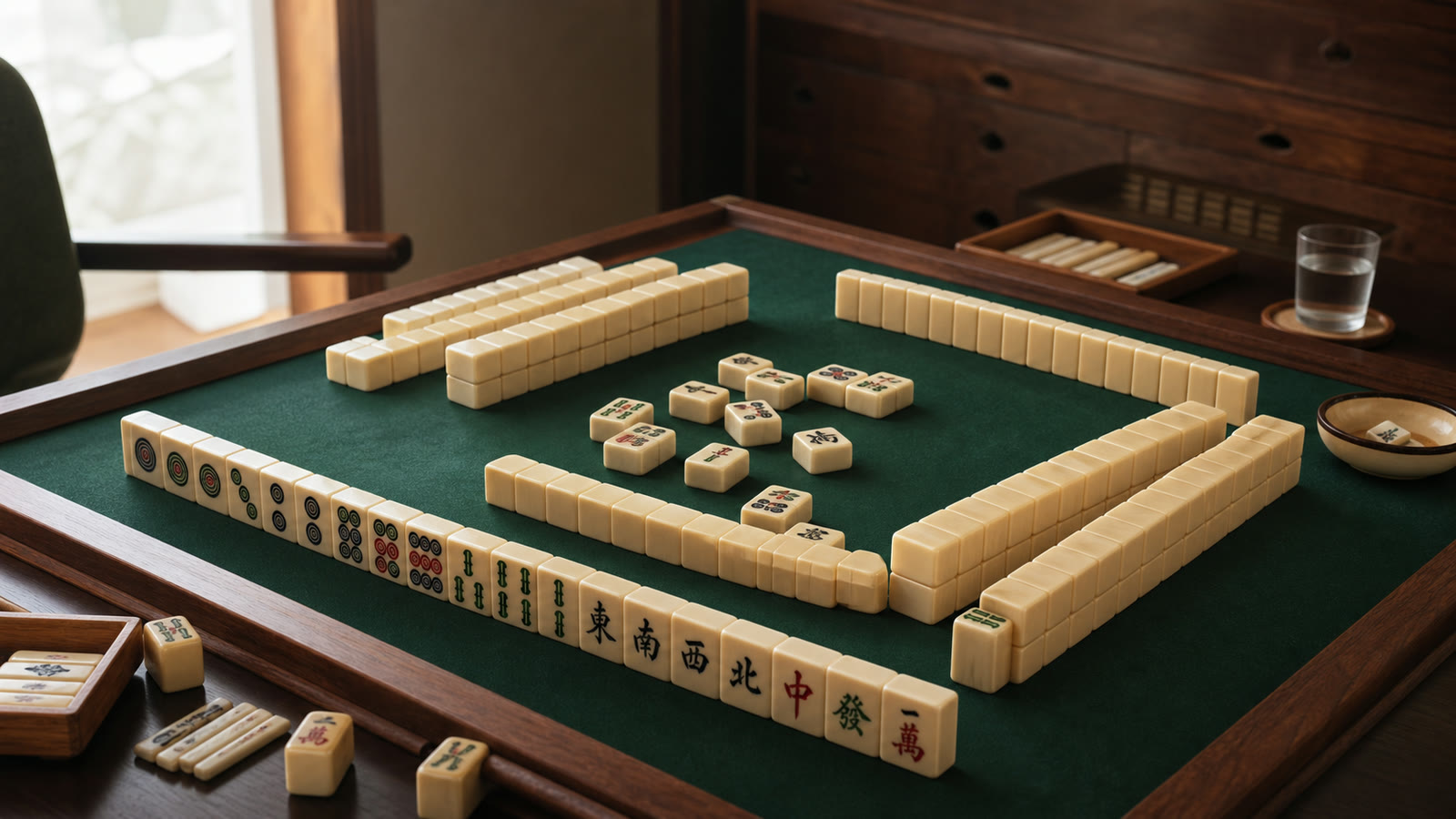
Explore Mahjong tile materials from bone and bamboo to plastics, resin, melamine, magnetic cores, modern collectible sets, table feel, and durability.
Read this post, then follow the linked practice or community path.
The live app experience on tsumo follows the same route structure, ruleset labels, and practice surfaces linked below.
Blog focus
Read the latest Mahjong blog posts from tsumo.
Follow internal links to connect each post back to local clubs, puzzles, tutorials, and playable routes.
By tsumo Editorial. Published 2026-06-29, updated 2026-06-29. 8 minute read.
Mahjong tile materials tell a practical history of craft, weight, sound, durability, mass production, and the changing meaning of a good set.
A Mahjong tile is a small piece of game design. Its material affects sound, weight, durability, legibility, cost, and even whether a table can use automatic shuffling hardware.
Mahjong tile materials tell a practical history of craft, weight, sound, durability, mass production, and the changing meaning of a good set. It connects material history to buying, collecting, teaching, cleaning, and automatic-table compatibility.
Museum, manufacturing, and Taiyo Giken equipment sources support material claims without authenticating individual collector sets.
Bone and bamboo as craft objects
Older sets often used layered materials that created a satisfying weight and tactile distinction. They also reflected the labor, cost, and regional craft practices behind game equipment.
Practice move: Treat antique materials as historical artifacts, not just luxury markers.
Early plastics and mass production
Plastic materials made Mahjong sets cheaper, more durable, and easier to distribute at scale.
That accessibility helped the game travel into homes, clubs, and export markets. The material shift changed who could own a set.
For most clubs, reliability matters more than romantic material history. Choose tiles that can survive repeated teaching sessions and transport.
Magnetic cores and automatic tables
Automatic tables require tile construction that works with the machine sorting and wall-building system. That practical requirement makes some beautiful sets unsuitable for machine play.
Practice move: Check table compatibility before buying replacement tiles.
What material tells players
Weight, sound, and legibility shape the experience of play, especially for beginners and older players.
A good set is not only attractive; it is readable, durable, and comfortable for a full session. Buy for the table you host, not only the shelf you display.
Practical Checklist
Prioritize legibility for teaching.
Check tile size against racks and tables.
Avoid fragile sets for public clubs.
Confirm automatic-table compatibility.
Store tiles consistently to prevent loss.
Where to Go Next
Learn Mahjong online - Use the beginner learning path when a piece raises a rule, scoring, or table-flow question you want to practice.
Find a Mahjong club - Use the club locator to turn cultural context into an in-person table, teaching session, or local meetup.
Practical Applications
Confirmed Material History vs. Lore
Tile-material history is full of collector lore, so material history should separate confirmed manufacturing context from attractive stories. Bone-and-bamboo sets, early plastics, modern resin and acrylic compositions, engraved faces, printed faces, and automatic-table-compatible tiles each reflect availability, cost, durability, and the needs of the table.
Confirmed practical point: material changes affect weight, sound, durability, cleaning, engraving, and machine compatibility.
Collector caveat: age, origin, and material claims should be checked against maker marks, case construction, tile dimensions, and specialist references.
Manufacturing caveat: a modern automatic table may require a specific tile size and magnetic profile, not just any beautiful set.
Ethics caveat: older animal-material sets should be discussed historically without romanticizing trade in ivory or other restricted materials.
A better buying guide asks how the set will be used. Display collectors may prize provenance and hand carving; teachers need legibility and replacement tiles; clubs need durable, washable sets; automatic-table owners need compatibility first.
The material story also explains why tiles feel culturally specific. Sound, heft, and surface texture shape memory. A plastic travel set and a heavy parlor set can teach the same rule while producing different rituals.
Collector and Player Perspectives
Collectors and active players ask different questions of the same set. A collector may care about age, case, maker, carving, material, completeness, and regional markings. A player may care about legibility, tile feel, replacement availability, washable surfaces, and whether the set fits racks or an automatic table. Material comparisons serve both groups by stating which lens is being used at each moment.
Material claims deserve careful language. Bone, bamboo, early plastic, Catalin or Bakelite-like materials, modern resin, and acrylic are often discussed casually online, but visual inspection alone can mislead. Without provenance or specialist testing, careful wording says appears to be or is commonly described as rather than making authentication claims.
The manufacturing angle also connects to accessibility. Mass-produced plastic sets helped Mahjong travel because sets became cheaper, more durable, and easier to replace. Premium sets and automatic-table tiles solve different problems: feel, longevity, compatibility, and room identity. No single material is historically or practically superior in every context.
For buying to play, prioritize complete tiles, readability, and replacement options.
For buying to collect, prioritize provenance, case integrity, maker clues, and ethical material concerns.
For clubs, prioritize durability and consistency across tables so beginners are not reading unfamiliar tile faces every week.
Care, Cleaning, and Use
Material history becomes practical when readers know how to care for sets. Modern plastic and resin tiles usually tolerate gentle cleaning with a soft cloth, but older sets, painted engravings, paper labels, bone-and-bamboo construction, and unknown adhesives deserve more caution. Care instructions should avoid universal rules and start by identifying material and condition.
For clubs, consistency matters more than romance. Mixed tile sizes, worn paint, missing flowers, and hard-to-read character tiles can slow beginners. A beautiful set may be better as a display or special-event set, while durable high-contrast tiles handle weekly teaching. This is a player-centered material decision rather than an aesthetic judgment.
The automatic-table connection is also important. A set that feels excellent by hand may be useless in a machine if it lacks the required magnetic or size profile. Readers should verify compatibility from the table or tile manufacturer before buying replacement sets.
Do not soak old or uncertain tiles without material-specific guidance.
Photograph unusual sets before repair so provenance clues are not lost.
For public clubs, choose legible faces and replaceable components before rare materials.
Material Language for Noncollectors
Noncollectors still benefit from material language. Knowing the difference between engraved and printed faces explains why some tiles wear differently. Knowing that tile thickness and weight affect shuffling explains why a travel set feels different from a parlor set. Knowing that automatic tables require compatible tiles prevents expensive mistakes.
Readers should use this practical language before collector terminology. A reader who only wants a first set needs confidence about durability, readability, and care. A reader who wants provenance can then move into deeper collector references without confusing display value with play value.
Tile Use Note
A set can be historically interesting, beautiful, and wrong for weekly play at the same time. Matching the material to the use case is the practical lesson.
Material Feel and Learning
Material feel affects learning. Heavy tiles make discards audible and satisfying, but they can fatigue some players. Small travel tiles are convenient, but they can be hard to read and easy to knock out of order. High-contrast modern faces help beginners; older carved sets may require more familiarity. Useful material history connects those physical differences to use cases instead of treating materials as collector trivia. A club set, teaching set, travel set, display set, and automatic-table set can all be good for different reasons. This framing keeps the history practical. Readers learn why materials changed over time, but they also learn how to choose tiles that fit the players, room, and frequency of use.
Source Notes and Limits
The cited sources use museum and manufacturing-history sources, current Taiyo Giken equipment material, and collector-oriented caution to keep material claims practical rather than exhaustive.
Material history includes lore and uncertain provenance. The buying guidance marks buying and collecting advice as verification steps, not authentication guarantees.
Quick FAQ
Are older tiles automatically better? No. Age, material, condition, completeness, legibility, and intended use matter more than nostalgia.
Can any tile set work in an automatic table? No. Automatic tables often require specific size, weight, and magnetic compatibility.
How should collectors handle material claims? Verify maker marks, measurements, case details, provenance, and specialist references before treating a claim as confirmed.
tsumo Editorial — tsumo Editorial is the organizational byline for source-backed Mahjong guides and articles published by tsumo. The team checks rules explanations against implemented app behavior and maintains corrections through the public contact process.
 tsumo
tsumo