By tsumo Editorial. Published 2026-05-02. 10 minute read.
A comprehensive guide to online Mahjong websites and apps. We break down the heavyweights of the Japanese Riichi scene, the specialized platforms of the American Mah Jongg ecosystem, and the versatile multi-variant rooms.
The online Mahjong landscape has exploded in recent years. What was once dominated by a few spartan, browser-based Japanese servers has now fragmented into a vibrant ecosystem of highly produced mobile apps, specialized learning tools, and distinct variant communities. This guide breaks down the major platforms for real-rule multiplayer Mahjong.
The Riichi Giants
Japanese Riichi Mahjong dominates the global competitive scene. The platforms that host it range from austere, math-heavy proving grounds to vibrant, anime-styled gacha games that have successfully exported the variant to the West.
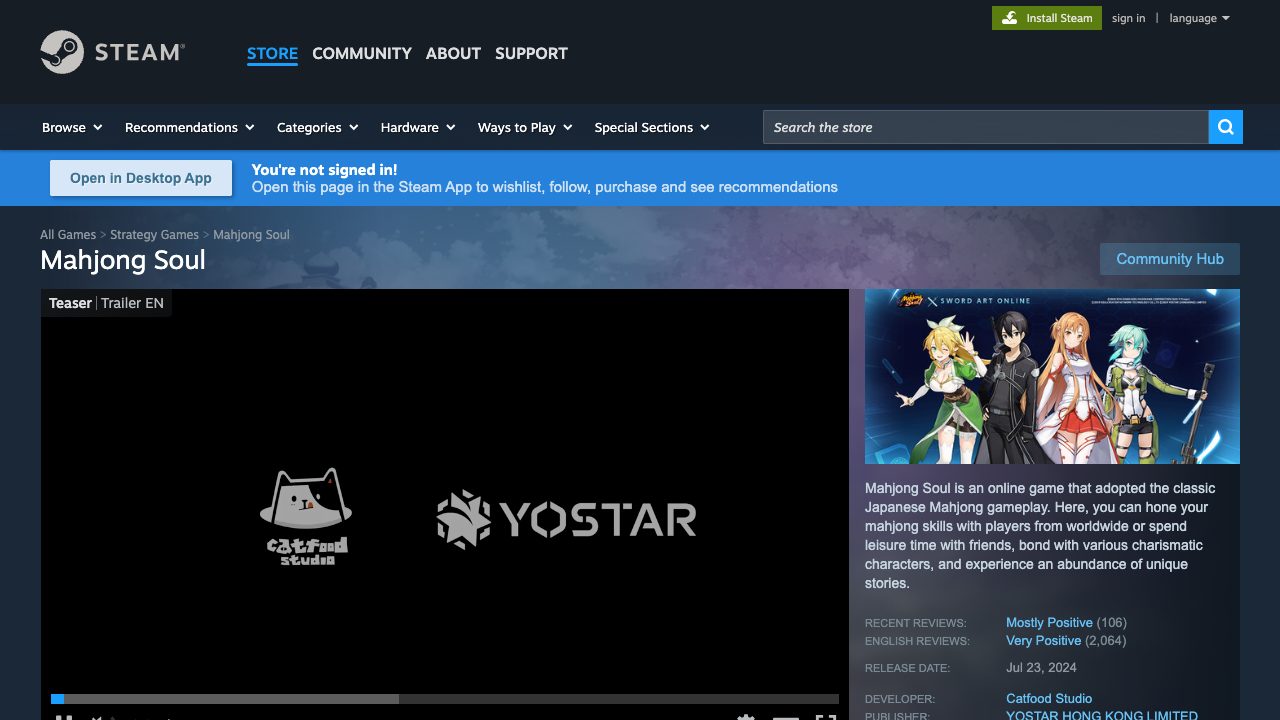
Mahjong Soul
Developed by Cat Food Studio and published by Yostar in 2018, Mahjong Soul (or Majsoul) is arguably the biggest catalyst for the modern global Mahjong boom. It is a highly polished Riichi client with ranked rooms, friend rooms, and seamless cross-play between web browsers, iOS, Android, and Steam. The game is heavily monetized through gacha mechanics, allowing players to pull for anime avatars, table skins, and dynamic win animations. Its regular collaborations with massive anime IPs like *Akagi*, *Saki*, and *Code Geass* ensure it remains the most visible and accessible entry point for new Western players.
Riichi City
Released globally in 2022, Riichi City is the most direct competitor to Mahjong Soul. It utilizes a similar anime-styled aesthetic and gacha monetization model but differentiates itself with a slightly faster in-game economy, slightly snappier tile animations, and an overarching "city" theme. It has aggressively pushed into the competitive sphere by hosting large international tournaments and remains a strong alternative for players looking for a fresh ladder to climb on Steam and mobile.
Tenhou
Created by C-EGG in 2006, Tenhou is the legendary proving ground of Riichi Mahjong. It features virtually zero graphical flair—no avatars, no gacha, no win animations. Instead, it offers a purely mathematical, lightning-fast interface designed for high-level play. Its brutal Elo-like ranking system is notorious; reaching the highest rank (Tenhoui) is a monumental achievement often equated with professional-level mastery. If Mahjong Soul is the vibrant arcade, Tenhou is the quiet, high-stakes backroom where the strongest players clash.
SEGA NET Mahjong MJ
Sega's official entry into the digital Riichi market brings the loud, bombastic energy of a Japanese arcade cabinet straight to PC and mobile devices. It features dramatic camera angles, explosive lighting effects when a player declares Riichi, and frequent tie-in events. Because it is heavily geared toward the domestic Japanese market, its presentation feels distinctly different—more like a televised sports broadcast than a quiet browser game.
Maru-Jan
Maru-Jan focuses intensely on realism. The platform goes to great lengths to simulate the physical properties of real automatic tables, meticulously calculating the weight of the digital tiles and randomizing the shuffling sounds based on real audio recordings. It charges a premium per game (acting effectively as a digital parlor fee), which cultivates an older, highly serious Japanese player base that treats each match with the gravity of real-life parlor play.
The American Ecosystem
Unlike Asian variants, American Mah Jongg changes its rules every year when the National Mah Jongg League (NMJL) issues a new card of winning hands. Digital platforms in this space face a unique challenge: they must function as robust learning environments and rules engines capable of enforcing the complex, ever-shifting constraints of the current year's card.
NMJL Online
This is the official online game provided by the National Mah Jongg League itself. Because it is directly tied to the league, it operates with a formal account and subscription flow. The interface is highly traditional and authoritative, catering explicitly to players who want the absolute most official digital realization of the current year's card without any unnecessary casual frills.
Real Mah Jongg
Real Mah Jongg is one of the premier subscription-based American platforms available via web and mobile apps. It perfectly simulates a digital club table, offering both multiplayer lobbies to find games against other humans and highly customizable bot matches. Its strength lies in its tight adherence to the NMJL rulebook and its clean, highly legible interface that makes matching tiles against the physical card intuitive.
I Love Mahj
I Love Mahj stands out as an incredibly robust learning tool. While it offers standard multiplayer and bot matches, its true value lies in its exercise modules. The site features dedicated tools to drill the Charleston passing phase, memorize the new annual card, and practice hand analysis. It is less of a generic gaming portal and more of an interactive curriculum for mastering American Mah Jongg.
Spring Mah Jongg
Spring Mah Jongg offers a visually simple, highly accessible browser-based American Mah Jongg experience. It prioritizes ease of use, allowing players to quickly spin up private tables for their friends or practice against bots. It avoids the heavy anime trappings of Asian clients, opting instead for a clean, card-centric presentation designed specifically for older, traditional player demographics.
MyJongg
MyJongg is a straightforward, older-style American Mah Jongg website. While it lacks the modern slickness of newer apps, it maintains a dedicated player base due to its reliable account-based play and easy-to-use private table features. It is a no-nonsense portal: log in, sit down, and play.
MahJongg4Fun
A more modern addition to the American scene, MahJongg4Fun utilizes a 3D presentation and cross-device account synchronization. It aims to bridge the gap between older web portals and modern mobile gaming, offering a slicker interface while rigidly adhering to the official NMJL rule-card play.
Eight Bam
Eight Bam operates primarily as a mobile practice companion rather than a bustling open multiplayer lobby. It is essential for players looking to sharpen their skills on the go, offering daily challenges, deep hand lookups, and focused drills. It is the perfect pocket tool to complement a player's physical, real-world club games.
Multi-Variant & Indie Platforms
Building a Mahjong platform that handles multiple regional variants is exceptionally difficult due to the wildly different scoring rules and table dynamics. However, a few ambitious platforms manage to host several rule sets under one roof.
Mahjong Time
Mahjong Time is an incredibly ambitious legacy platform. It is one of the only major sites to successfully host active communities for Japanese Riichi, Chinese Official (MCR), Hong Kong, Taiwanese, and American Mah Jongg simultaneously. While the graphical interface is notably dated, its unparalleled breadth of variant support makes it a historically significant and highly useful hub for diverse global players.
Mahjong 4 Friends
Aimed squarely at private groups, Mahjong 4 Friends is a highly accessible web and mobile app that supports American, Chinese, Hong Kong, and British rule variations. Its primary strength is its low barrier to entry: it is designed to let four real-life friends easily jump into a digital room together without needing to navigate complex server ladders or deep account systems.
Board Game Arena
Board Game Arena (BGA) is a massive portal for hundreds of board games, and its implementation of Japanese Riichi Mahjong is surprisingly robust. While it lacks the dedicated bells and whistles of a specialist app like Mahjong Soul, it is the perfect platform for board game enthusiasts who want to dabble in Mahjong without leaving an ecosystem they are already familiar with.
Mahjong Friends Online
This platform takes a unique 'sandbox' approach. Rather than relying on a strict rules engine that forces the game to play a certain way, Mahjong Friends Online acts as a digital tabletop where players manually move tiles and enforce their own house rules. This makes it the ultimate solution for tight-knit groups whose specific local rules aren't supported by major automated clients.
MahJongo
MahJongo is a modern, versatile web platform that covers a wide spread of variants, including Riichi, Chinese Official, Sichuan, Hong Kong, Taiwanese, and American Mahjong. It positions itself not just as a place to play, but as a comprehensive learning hub, offering interactive tutorials that make it an excellent starting point for players looking to explore rulesets outside their comfort zone.
Sources and Further Reading
- Mahjong Soul Steam page, Steam
- Riichi City Steam page, Steam
- Tenhou official site, Tenhou
- SEGA NET Mahjong MJ Google Play listing, Google Play
- Maru-Jan official site, SignalTalk
- Mahjong Time official overview, Mahjong Time
- Board Game Arena Japanese Mahjong page, Board Game Arena
- Mahjong 4 Friends App Store listing, Apple App Store
- NMJL Online official page, National Mah Jongg League
- Spring Mah Jongg official site, Spring Mah Jongg
- I Love Mahj play page, I Love Mahj
- Real Mah Jongg official site, Real Mah Jongg
- MyJongg help page, MyJongg
- MahJongg4Fun official site, MahJongg4Fun
- Eight Bam official site, Eight Bam
- Mahjong Friends Online manual, Mahjong Friends Online
- MahJongo official site, MahJongo
How This Connects to Practice
This editorial piece is part of the same public learning system as the rules guides, tutorial routes, puzzles, and club locator. Use the article for context, then use the linked tsumo guides or practice routes to test the same ideas in concrete Mahjong decisions.
Editorial Notes for Players
For Online Mahjong Sites and Apps, the useful takeaway is not only the history, culture, or design detail. Read it against the rules questions that appear at a real table: what decisions players must make, which customs are local, and which claims, scoring rules, or etiquette points depend on the chosen variant.
Tsumo keeps this online mahjong article linked to practical pages so readers can separate background material from playable rules. If a rule or term sounds unfamiliar, check the glossary and the matching rules guide before carrying it into a live session.
Related Mahjong Editorial
 tsumo
tsumo