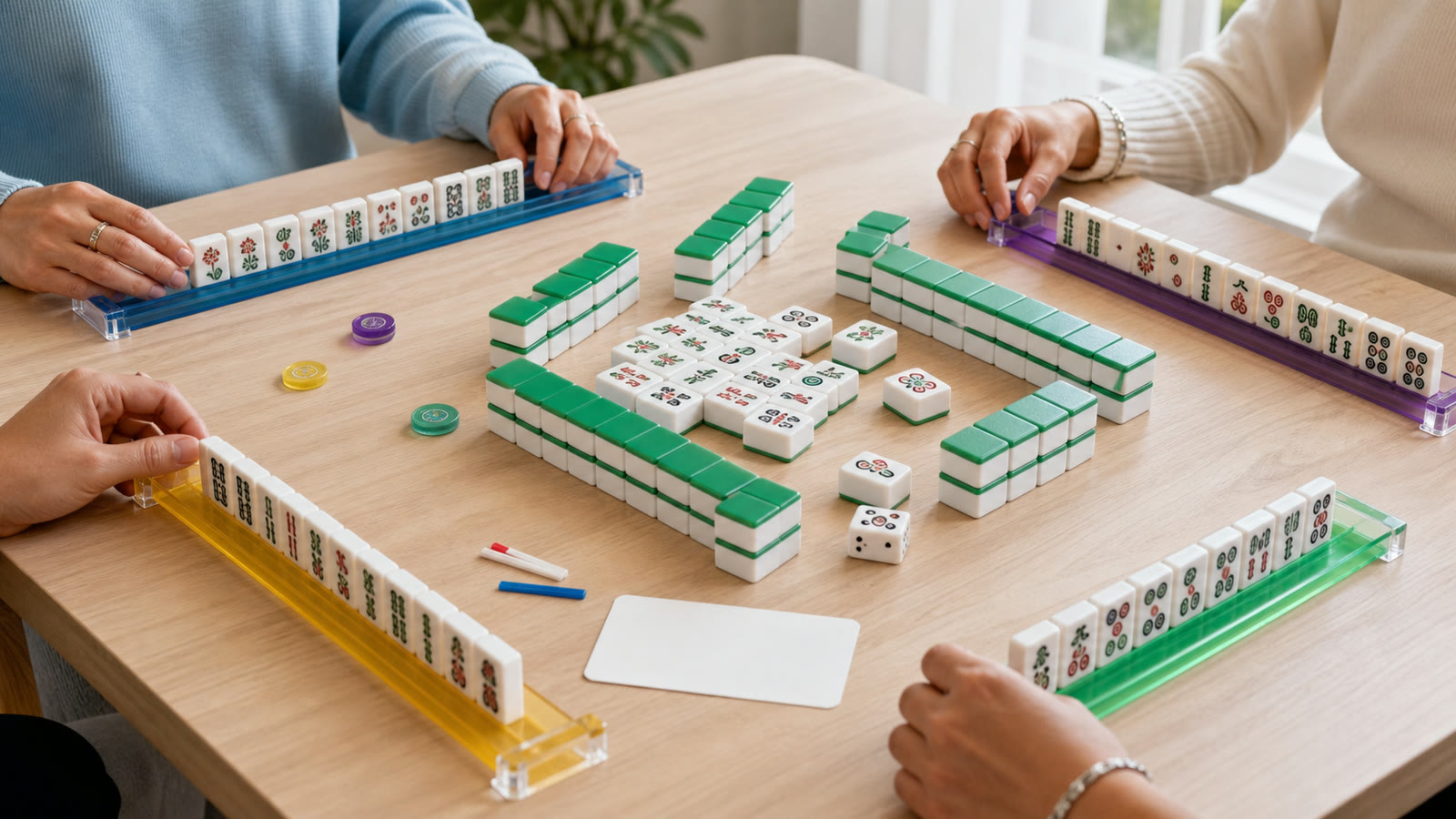
Compare American Mah Jongg and Asian Mahjong by annual card, jokers, Charleston, hand structure, scoring, etiquette, learning path, and table feel.
Read this post, then follow the linked practice or community path.
The live app experience on tsumo follows the same route structure, ruleset labels, and practice surfaces linked below.
Blog focus
Read the latest Mahjong blog posts from tsumo.
Follow internal links to connect each post back to local clubs, puzzles, tutorials, and playable routes.
By tsumo Editorial. Published 2026-06-25, updated 2026-06-29. 10 minute read.
American Mah Jongg uses annual card patterns, jokers, racks, and the Charleston, while many Asian variants center on flexible groups, local scoring, and different claim rules.
American Mah Jongg and Asian Mahjong share tiles and family resemblance, but they train different instincts. American play is card-driven and pattern-specific; many Asian variants are group-building games with local scoring systems and different value gates.
American Mah Jongg uses annual card patterns, jokers, racks, and the Charleston, while many Asian variants center on flexible groups, local scoring, and different claim rules. It gives mixed-table players a respectful way to compare card-driven and fixed-rule Mahjong systems.
NMJL, WRC, Riichi Book 1, and international rules references support the comparison between American card play and fixed-rule variants.
The annual card changes everything
American Mah Jongg revolves around a published card of legal hands, so hand selection begins before the first discard. That makes pattern recognition more like navigating a changing menu than building any four groups and a pair.
Practice move: A new American player should study the card categories before memorizing tile efficiency advice from other variants.
Jokers and exposure logic
Jokers make American Mah Jongg more flexible in some exposed groups, but they also introduce exchange rules and defensive signals.
Asian variants may have bonus tiles or red fives, but they usually do not use jokers in the same card-driven way. When switching games, reset your assumptions about what a visible group reveals.
The Charleston as pre-hand strategy
The Charleston gives American tables a structured passing phase that can improve or distort early direction.
Most Asian variants begin with immediate draw-discard flow, so early planning feels very different. Treat the Charleston as part of hand selection, not as a social warmup.
Scoring and legality differ
In many Asian variants, a complete structure may still need yaku, tai, faan, or points before it is legal or valuable. In American Mah Jongg, the card defines the target and payout schedule in a different way.
Practice move: Always ask what makes a hand legal before asking how much it scores.
Table culture and equipment
Racks, pushers, calling language, table cards, and teaching habits make American Mah Jongg feel distinct even before scoring begins.
Asian tables vary widely too, but many rely more directly on discard pools, meld visibility, and local verbal conventions. Respect the equipment as part of the rules environment.
Which one should you learn first?
Learn the version your community plays first, then choose a second ruleset for contrast.
American Mah Jongg strengthens card planning; Riichi strengthens defense; Chinese and MCR styles strengthen pattern and scoring vocabulary. Cross-training is useful only when you stop importing the wrong assumptions.
Practical Checklist
Ask whether the table uses a card.
Confirm joker and exchange rules.
Learn the Charleston before judging early discards.
Do not apply Riichi yaku logic to American hands.
Use one ruleset vocabulary at a time.
Where to Go Next
Learn Mahjong online - Use the beginner learning path when a piece raises a rule, scoring, or table-flow question you want to practice.
Read Chinese Mahjong rules - Review the simplified Chinese rules guide when the history or culture discussion turns back into table procedure.
Read Riichi rules - Use the Riichi rules guide for yaku, furiten, reach declarations, and push-fold decisions mentioned here.
Practical Applications
Side-by-Side Rule Table
The most actionable comparison starts with table mechanics. American Mah Jongg uses a yearly National Mah Jongg League card, jokers, racks, Charleston passing, and hands that must match card categories. Many Asian variants use no yearly card, treat jokers differently or not at all, and build value through sets, pairs, waits, patterns, and scoring rules that stay stable across the year.
Hand menu: American play asks which card hand you are pursuing; Riichi and many Chinese variants ask whether the shape is legal and valuable under fixed rules.
Jokers: American play makes joker management central; Riichi has no jokers, while other variants may use flowers, seasons, or local bonus tiles instead.
Charleston: American play begins with structured passing; most Asian variants start directly from the deal and draw-discard rhythm.
Claims: all variants care about exposed information, but the exact priority, timing, and strategic cost differ by ruleset.
Scoring: American tables usually score by the card; Riichi uses yaku, han, fu, and limit hands; MCR uses a pattern-point system.
For a mixed table, the practical solution is not to debate which family is harder. Pick the table language before tiles move: card or no card, joker or no joker, Charleston or no Charleston, teaching mode or regular play. Those choices prevent most cross-variant frustration.
The comparison also helps online learners choose software. A Riichi app will not prepare a player for Charleston timing, and an American app will not teach furiten or riichi pressure. Use the variant you intend to play as the anchor.
Translation Problems at Mixed Tables
Mixed tables often stumble because players use familiar words for different systems. A set, exposure, chow, pung, pon, sequence, joker, flower, yaku, fan, and card hand can sound like interchangeable vocabulary until a live decision depends on the difference. A useful comparison slows down and defines the decision each word controls.
For example, an American player may treat jokers as flexible rescue tiles and expect passing to shape the opening. A Riichi player may be thinking about closed-hand value, riichi timing, and whether a call destroys yaku. A Taiwanese player may be planning around a larger hand where a shape that looks loose in 13-tile play still has room to develop. None of those players is confused inside their own system; confusion appears when the table never names the system.
The practical bridge is a pre-game translation round. Ask each player to explain one rule from their home variant that will not apply tonight. That small ritual lowers defensiveness and gives the host permission to redirect advice that belongs to another game.
If the table uses a card, show the card and explain how hands are selected.
If the table uses yaku or fan, explain the minimum value requirement before calls begin.
If the table uses jokers, explain exchange rules and limits before the first Charleston or draw.
If the table uses no Charleston, tell American players when opening decisions actually begin.
Actionable Bridge Exercises
A bridge exercise for American-to-Riichi learners is to remove the card and ask what makes a hand legal. The player must stop searching for a printed hand category and start looking for yaku, closed versus open value, waits, and final shape. A bridge exercise for Riichi-to-American learners is to deal racks, complete Charleston, and ask which card families remain plausible before any draw occurs. The opening decision moves earlier.
For Chinese-family or MCR learners, the bridge is scoring vocabulary. A player coming from American Mah Jongg may be comfortable with named hands but unfamiliar with point patterns that combine. A Riichi player may understand yaku but need to learn a broader fan catalog or different minimum gate. Treat this as translation work, not as a hierarchy of sophistication.
Mixed groups should use a visible comparison card for the first few sessions. The card can list turn structure, calls, jokers, passing, win requirement, scoring authority, and what counts as a mistake. The goal is not to teach every variant at once; it is to prevent players from applying a rule that belongs to yesterday's table.
American-to-Riichi focus: yaku, furiten, riichi declaration, and no jokers.
Riichi-to-American focus: yearly card, Charleston, joker exchange, and exposure management.
Chinese/MCR bridge focus: fan or pattern vocabulary, scoring gate, and local call priority.
Respectful Comparison Language
Comparisons can easily become rankings, so respectful language matters. American Mah Jongg is not simplified Asian Mahjong; it is a card-driven branch with its own memory, joker, and social skills. Riichi is not the only strategic version; it is a highly documented branch with formal defense and scoring language. Chinese and international variants are not background categories; they are rule systems that deserve specific names.
This tone improves usefulness. Players who feel their home game is being dismissed will not trust the guide. Players who see the exact decision differences will be more willing to try another variant without defensiveness.
Mixed Group Success Note
The best mixed-group outcome is not that every player converts to one style. It is that each player can name what tonight's rules reward and stop giving advice from a different game.
Comparison Without Ranking
A useful comparison helps readers translate habits without ranking communities. American Mah Jongg teaches card reading, joker timing, Charleston discipline, and social table rhythm. Riichi teaches yaku legality, furiten awareness, defensive folding, and score pressure. MCR and regional Chinese variants teach pattern vocabulary, fan or point gates, and different call incentives. Taiwanese and Filipino tables change planning through larger hand structures. None of these skills is a lesser version of another. The same tiles can support different kinds of expertise. That tone is not just polite; it is accurate. Players learn faster when they stop defending their home rules and start asking what tonight's rules reward.
The practical benefit of that comparison is smoother hospitality. A host can welcome players from several backgrounds by naming which familiar habits are useful tonight, which habits should be paused, and where each player can learn the active table language without embarrassment.
Source Notes and Limits
The cited sources combine National Mah Jongg League context, WRC rules, Riichi Book 1, and international rules references so the comparison covers both American card-driven play and fixed-rule Asian variants.
Asian Mahjong is not one ruleset. This advice uses broad contrasts only when they help readers avoid the most common cross-variant mistakes, then points them toward specific rule pages.
Quick FAQ
What is the fastest way to avoid confusion? Say card or no card, jokers or no jokers, Charleston or no Charleston, and which scoring system is active before the first deal.
Does American Mah Jongg use the same strategy as Riichi? Only some general habits transfer; card reading, joker use, and Charleston planning create a very different decision tree.
Why say Asian variants instead of Asian Mahjong? Because Riichi, MCR, Taiwanese, Filipino, and family Chinese rules can differ substantially despite sharing tile ancestry.
tsumo Editorial — tsumo Editorial is the organizational byline for source-backed Mahjong guides and articles published by tsumo. The team checks rules explanations against implemented app behavior and maintains corrections through the public contact process.
 tsumo
tsumo