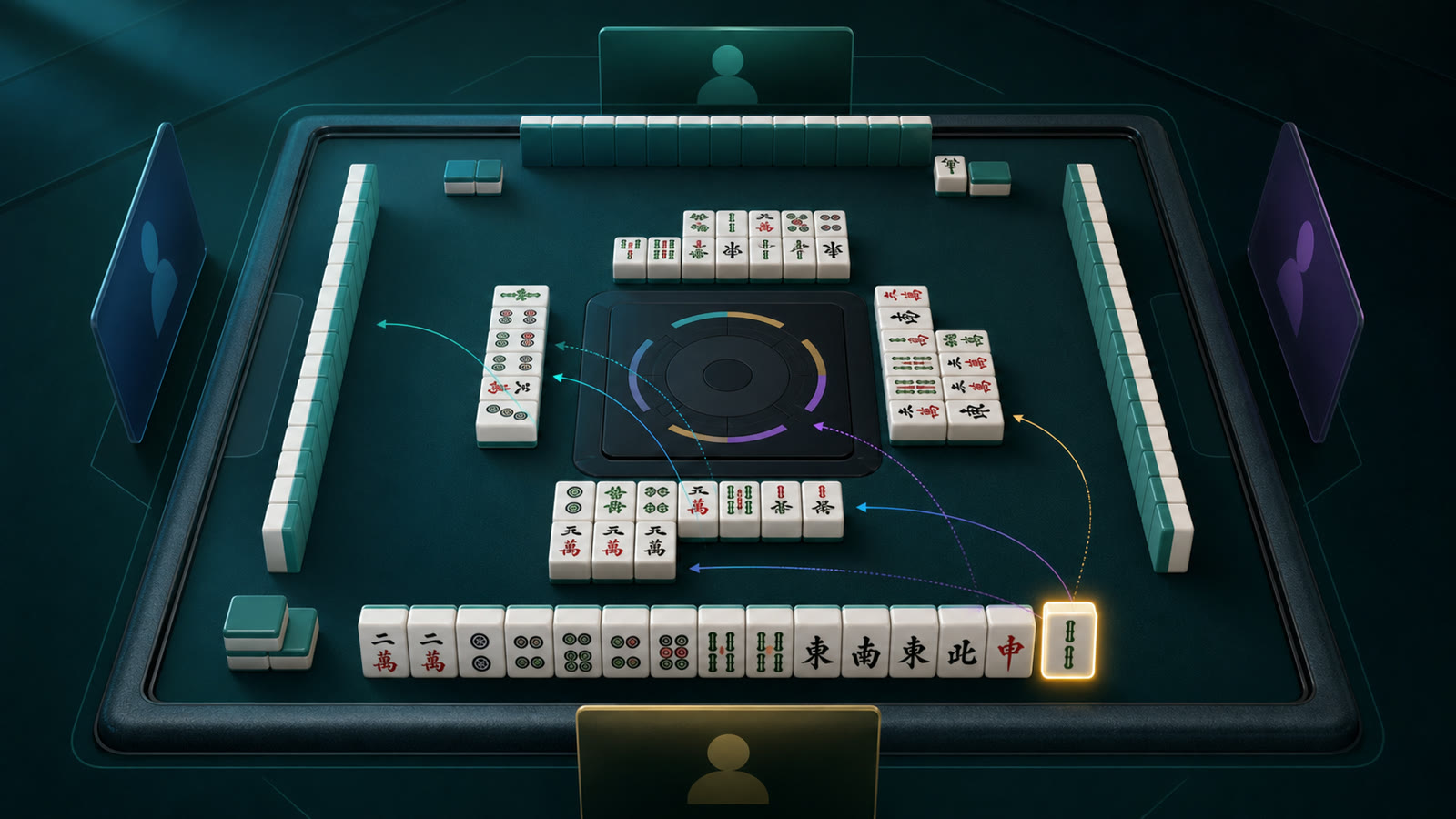
Trace Mahjong technology from printed cards and automatic tables to browser engines, scoring automation, online rooms, replays, and AI study.
Read this post, then follow the linked practice or community path.
The live app experience on tsumo follows the same route structure, ruleset labels, and practice surfaces linked below.
Blog focus
Read the latest Mahjong blog posts from tsumo.
Follow internal links to connect each post back to local clubs, puzzles, tutorials, and playable routes.
By tsumo Editorial. Published 2026-06-29, updated 2026-06-29. 8 minute read.
Mahjong technology has moved from printed rules and physical tiles to automatic tables, online engines, replay review, and AI-assisted study.
Mahjong technology is the story of reducing friction without removing the game. Printed references, automatic tables, online rooms, scoring engines, and AI review tools all try to make complex play easier to start, verify, or study.
Mahjong technology has moved from printed rules and physical tiles to automatic tables, online engines, replay review, and AI-assisted study. It positions digital Mahjong as rules automation, replay data, interface trust, and AI-shaped study.
Official platform sources, table references, and Microsoft Suphx research support the software, replay, and AI-study discussion.
Printed rules were technology too
Rule cards, score tables, and annual cards changed how players learned and standardized table decisions. They made Mahjong portable by putting authority in a document the table could consult.
Practice move: Digital tools still perform the same job when they explain why an action is legal.
Automatic tables changed physical pace
Mechanical shuffling and wall building reduced setup time and supported high-volume play.
The machine did not change the rules, but it changed the rhythm of rooms and tournaments. Technology often changes behavior before it changes strategy.
Online engines enforce legality
A digital Mahjong engine must know turn order, claim priority, hand shape, scoring, draws, disconnects, and edge cases.
That automation protects beginners from illegal moves but can hide rule reasoning if the UI is silent. The best clients explain decisions, not only enforce them.
Replay and data changed study
Digital play creates records that physical tables rarely preserve. Replays let players inspect discard choices, missed waits, and defensive moments long after the emotion of the hand fades.
Practice move: Review one hand deeply instead of skimming ten losses.
AI as a study partner
AI systems can evaluate large decision spaces and challenge human assumptions about speed, value, and danger.
They are most useful when the player asks why a choice differs, not when the player copies output blindly. AI study should strengthen explanation.
The future is hybrid
The strongest Mahjong technology will connect rules, practice, clubs, and live tables instead of isolating players in one mode.
A browser game, puzzle system, and club locator can support the same learning journey from different angles. Use technology to get people to better hands and better tables.
Practical Checklist
Use digital enforcement to learn rules, not skip them.
Review replays for one decision at a time.
Check platform settings before comparing results.
Use AI output as a question generator.
Connect online practice to live play.
Where to Go Next
Practice Mahjong decisions - Daily puzzles are the fastest way to turn guidance advice into repeatable tile-reading decisions.
Read Riichi rules - Use the Riichi rules guide for yaku, furiten, reach declarations, and push-fold decisions mentioned here.
Practical Applications
Software Engine Focus
Digital Mahjong technology is different from automatic-table hardware. It is primarily about rules engines, state validation, replay data, matchmaking, scoring automation, fraud prevention, and interfaces that teach players what just happened. The invisible work is deciding which actions are legal at every moment and explaining the result quickly enough that players trust the client.
Rules automation: the engine must know turn order, claim windows, hand legality, scoring, penalties, and optional settings.
Replay data: saved hands turn entertainment into study because players can inspect the exact decision point later.
Interface design: the client must show danger, calls, points, and remaining tiles without creating illegal advice in competitive rooms.
AI study: research systems such as Suphx show how large-scale self-play and evaluation can influence human review habits.
Platform operations: accounts, moderation, disconnect handling, and anti-cheat policies matter as much as tile graphics.
The through-line from paper scoresheets to online clients is accountability. A physical table relies on shared memory and etiquette; a digital table relies on logged state. Good software should make the rules more visible, not merely faster.
For players, the technology question is practical: does the app help you understand why a move was legal, why a win scored that way, and what you could review afterward? If not, it may be a fine game room but a weak teacher.
What Digital Clients Must Get Right
A digital Mahjong client succeeds when players trust the state. The client must know whose turn it is, which calls are legal, when a win can be declared, how the score is calculated, and what optional rules were active. If any of those answers are hidden, the app may still be entertaining, but it is a weak learning environment.
Treat replay as a major technology, not a minor feature. Replays make Mahjong searchable. A player can return to the exact discard, score, and visible pool that created a mistake. That is a different learning model from a physical table, where memory and social discussion often decide what happened.
Rules engine quality shows up when edge cases are explained clearly.
Interface quality shows up when players know why a button appears or disappears.
Training quality shows up when a player can review one decision without replaying an entire session from memory.
Community quality shows up in moderation, private-room controls, and disconnect handling.
Data That Helps Humans Learn
Not all digital data is equally useful. A win-rate graph can motivate players, but a replay with decision points teaches more. A rank badge can create pressure, but a scoring explanation builds understanding. A discard heatmap may be interesting, but only if the player can connect it to hand shape, danger, and score situation.
Humane technology means for humane technology. The best clients reduce bookkeeping while still showing enough state for players to learn. They do not hide rules behind animation, bury scoring details, or make every hand feel disposable. Mahjong software should preserve the inspectability of the table even as it removes physical friction.
For beginners, the most valuable data is why a win is legal or illegal.
For intermediate players, the most valuable data is the decision point before the hand outcome.
For advanced players, the most valuable data is repeatable pattern review across many similar hands.
Digital Trust
Digital trust is the thread that ties the advice together. Players trust a physical table because they can see the wall, discards, and other hands only when exposed. Players trust a digital table because the client enforces hidden state correctly and explains visible state clearly. When that trust breaks, no amount of polished animation can make the game feel fair.
Rules Engines as Teachers
A digital Mahjong client teaches even when it does not intend to. The buttons it enables, the warnings it shows, the scoring breakdown it reveals, and the replay data it saves all shape player intuition. If the client hides why a win is illegal or why a call is unavailable, beginners may memorize interface behavior without understanding rules. If the client exposes the reasoning clearly, it becomes a teacher. Readers should use that standard when discussing technology. Graphics, speed, and matchmaking matter, but rules transparency is the feature that turns digital play into durable learning. This also explains why replay tools and AI review belong in the same conversation as online tables.
Source Notes and Limits
The cited sources combine official online-platform sources, automatic-table references, and Microsoft Research on Suphx for AI context while repositioning this guidance around software systems.
Platform features and app availability can change quickly. The discussion treats examples as current to the access date and asks readers to verify the official client before relying on a feature.
Quick FAQ
What is the difference between digital tiles and automatic tables? Automatic tables solve physical setup; digital clients solve rules state, scoring, matchmaking, replay, and interface problems.
What makes a Mahjong app a good teacher? It should explain legal actions, scoring, mistakes, and replays instead of only dealing fast hands.
Why include AI research here? AI study belongs here when it shows how software changes review habits, not as a promise that every player should copy model choices.
tsumo Editorial — tsumo Editorial is the organizational byline for source-backed Mahjong guides and articles published by tsumo. The team checks rules explanations against implemented app behavior and maintains corrections through the public contact process.
 tsumo
tsumo