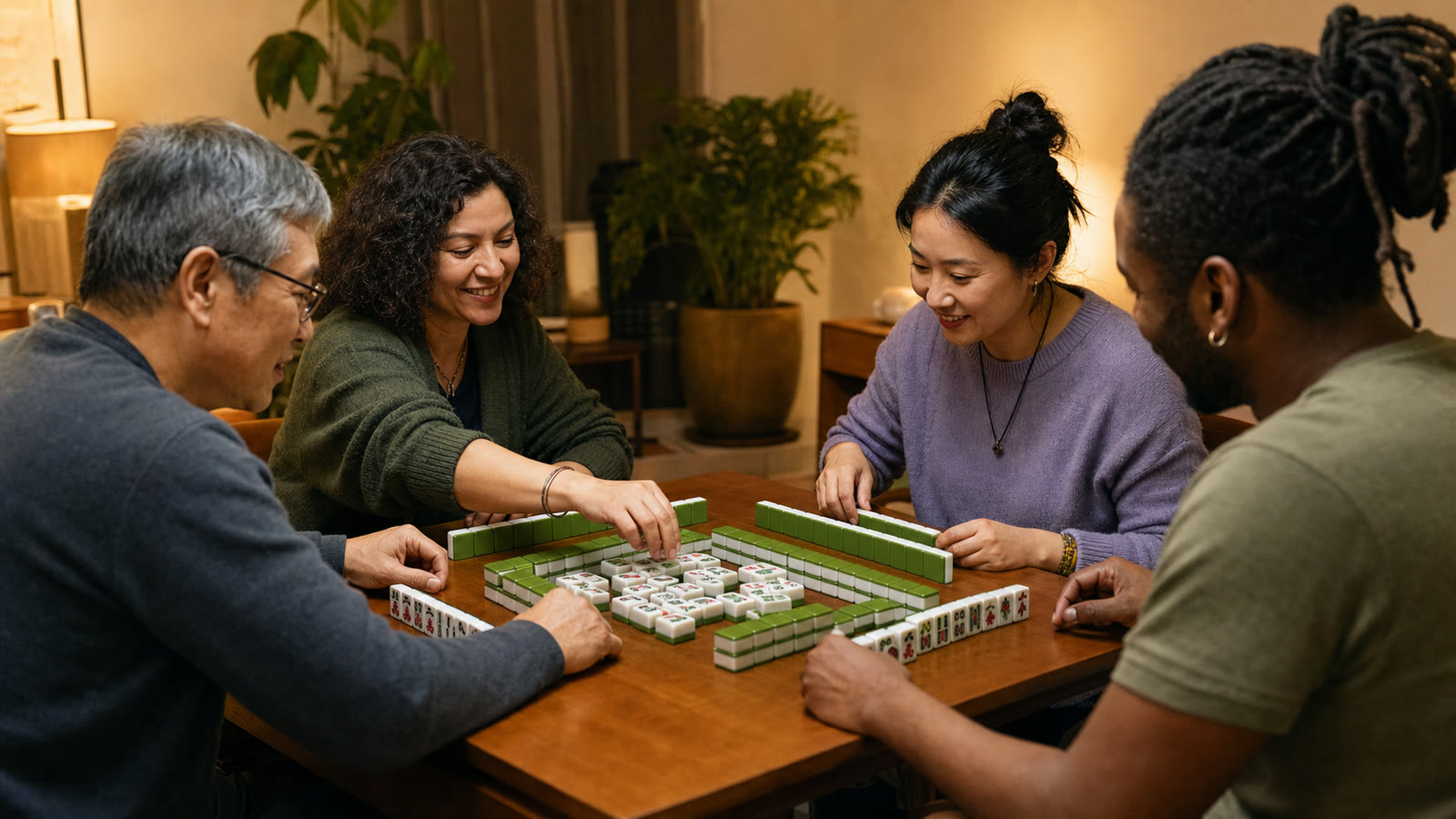
Build a Mahjong community with recurring events, beginner tables, clear rules, venue planning, digital coordination, organizer systems, and retention.
Read this post, then follow the linked practice or community path.
The live app experience on tsumo follows the same route structure, ruleset labels, and practice surfaces linked below.
Blog focus
Read the latest Mahjong blog posts from tsumo.
Follow internal links to connect each post back to local clubs, puzzles, tutorials, and playable routes.
By tsumo Editorial. Published 2026-06-29, updated 2026-06-29. 10 minute read.
Strong Mahjong communities need regular tables, beginner pathways, clear rules, venue discipline, organizer succession, and a bridge between online and local play.
A Mahjong community is not created by one successful event. It is created by repetition: a place, a schedule, a ruleset, a teaching path, and enough organizer discipline that people know the table will still exist next month.
Strong Mahjong communities need regular tables, beginner pathways, clear rules, venue discipline, organizer succession, and a bridge between online and local play. It treats community building as shared operations: roles, cadence, equipment, onboarding, and succession.
Trend, cultural, organizational, and peer-reviewed social-activity sources support the operational community model cautiously.
Start with a repeatable promise
New communities fail when every event is improvised. Players need to know who is welcome, which rules are used, whether beginners can learn, and how long the session runs.
Practice move: Publish a simple promise and keep it for several meetings before expanding.
Separate beginner and regular needs
Beginners need time, explanation, and psychological safety; regulars need pace, challenge, and continuity.
Forcing both groups into one table can frustrate everyone. Use teaching tables, rotation, or scheduled lesson hours when attendance grows.
Choose venues for noise and flow
Mahjong needs table space, sound tolerance, good lighting, and enough room for players to watch without crowding.
A beautiful venue that makes teaching impossible will not serve the club. Test the room with a full table before advertising a large event.
Use digital tools between meetings
Discord, mailing lists, and event pages are useful for reminders, rules links, RSVP, and post-game questions. They should reduce uncertainty rather than become another place people must constantly monitor.
Practice move: Keep the next event and rules reference easy to find.
Build organizer succession
A club that depends on one host is fragile.
Train scorekeepers, table teachers, equipment owners, and backup organizers before the group feels stretched. Community health is an operations problem as much as a social one.
Connect clubs to practice
Players return when they can feel improvement between sessions.
Rules guides, puzzles, and online friend rooms can keep momentum alive after the venue closes. Give every new player one practice action they can do before the next meeting.
Practical Checklist
Pick a recurring cadence.
Publish rules and beginner status.
Keep equipment inventory simple.
Create a backup-host list.
Send one practice link after each event.
Where to Go Next
Find a Mahjong club - Use the club locator to turn cultural context into an in-person table, teaching session, or local meetup.
Learn Mahjong online - Use the beginner learning path when a piece raises a rule, scoring, or table-flow question you want to practice.
Practice Mahjong decisions - Daily puzzles are the fastest way to turn guidance advice into repeatable tile-reading decisions.
Practical Applications
Organizer Operating Model
A durable Mahjong community needs roles, cadence, equipment, onboarding, and succession. One charismatic host can start a table, but a club lasts when the work is visible and shared. The operating model should be simple enough that another volunteer can run the night without reinventing the room.
Cadence: a predictable weekly or monthly table beats sporadic special events for retention.
Equipment: labeled sets, spare dice, rules cards, score sheets, cleaning supplies, and a plan for damaged tiles.
Onboarding: one beginner table, one regular table, and a written promise about how corrections will be handled.
Succession: document venue contacts, passwords, storage location, and refund policy before the founder burns out.
Community building also distinguishes audience from membership. A viral piece may fill one night, but membership grows when people know the next date, the variant, the cost, and where they fit if they are new.
The safest social-benefit language is operational: recurring play can create companionship, routine, and intergenerational contact. Stronger health claims require stronger study design than a club organizer usually has.
Membership Lifecycle
A community operating model describes the full member lifecycle. Discovery is how someone hears about the table. Orientation is what happens before the first hand. Belonging is the moment they know the group expects them back. Contribution is when they bring a set, teach a newcomer, handle signups, or host a table. Succession is when the club can survive without the founder running every detail.
Each stage needs a different artifact. Discovery needs a public page or listing with date, place, cost, and variant. Orientation needs a beginner note, table rules, and correction style. Belonging needs recurring dates and names, not just a group chat. Contribution needs small jobs that do not require expert play. Succession needs passwords, venue contacts, equipment inventory, and a decision process.
Organizers also need to name the common failure modes. Clubs stall when they rely on one host, mix too many variants without labeling them, let advanced players dominate correction, store equipment in an inaccessible place, or make newcomers ask private permission for basic information. These are solvable design problems, not personality flaws.
First month: publish the variant, venue, RSVP path, and beginner policy.
Second month: train two table captains and write down house-rule decisions.
Third month: create a supply checklist and a substitute-host plan.
Sixth month: ask members what role they can take before the founder is exhausted.
Metrics That Matter for a Club
Community builders should measure more than attendance. A full room can still be fragile if beginners do not return, equipment is failing, one host does all the work, or players split into cliques by variant. Better metrics include repeat attendance, number of trained table captains, number of beginners who move to regular play, equipment readiness, and how many people know how to open and close the venue.
Organizers also benefit from lightweight documentation. A club can keep a one-page operations note: venue contact, storage location, table count, active variants, beginner policy, correction style, RSVP link, refund or fee policy, and emergency contact. This is not bureaucracy for its own sake; it is what lets the table continue when the founder is sick or traveling.
Conflict policy matters too. Mahjong groups can fracture over money, pace, variant preference, teaching style, or perceived disrespect. A durable club names how decisions are made. Does the host decide? Do members vote? Are some nights variant-specific? Can a player appeal a correction? The clearer the policy, the less the group relies on social guessing.
A final community-building improvement is to separate growth from health. Growing bigger is useful only if the experience remains coherent. Sometimes the next responsible step is a second table captain, not another publicity push. Sometimes it is a quieter beginner night, not a tournament. Competitive coverage should give organizers permission to build capacity before visibility.
Onboarding Script for New Members
Community organizers need words they can use. Welcome, tonight we are playing Riichi with teaching allowed at this table. You do not need to know scoring yet. Ask rules questions any time before discarding, and after the hand we will review one decision if you want. That short script answers variant, permission, expectation, and psychological safety in under a minute.
For an American Mah Jongg night, the script changes: welcome, tonight we are using the current NMJL card. We will explain Charleston before the first pass, and joker questions are welcome during the teaching round. For a mixed Chinese-family table, the script might say: welcome, these are our house rules, and we will write down any rule that differs from what you learned elsewhere.
Every club should write its own version of the script. A script is not artificial; it prevents newcomers from relying on the confidence of the loudest person in the room. It also makes the club easier to hand off because hospitality becomes a repeatable practice.
Community Quality Note
Community quality is visible in ordinary handoffs. Can a substitute host find the tiles, welcome a new player, explain the variant, collect a fee if needed, and close the venue without calling the founder? If yes, the club has become an institution rather than a personality project. That is the real marker of durability.
A mature club also knows when to stay small. If four tables create confusion and two tables create belonging, the smaller version may be healthier until more table captains, teachers, and equipment systems are ready.
The same discipline makes growth less fragile: when roles, rules, and hospitality are shared, new members join a system instead of depending on one exhausted organizer.
That restraint protects the room players already trust and gives new volunteers a stable pattern to inherit.
Operational Memory
Community durability depends on operational memory. If only one person knows where the tiles are stored, which venue contact approves dates, how fees are collected, or which house rule was settled last month, the club is fragile. Organizers should write those details down while the group is still small. Documentation does not need to be formal; a shared note with venue, equipment, variant, beginner policy, and host backup is enough to prevent avoidable confusion. Operational memory also makes a club more welcoming. New volunteers can help without guessing, and newcomers see a table that feels cared for. That is the difference between a recurring event and a community that can outlast its founder.
A good community plan makes the invisible work visible. The person who brings tiles, explains rules, books the room, welcomes beginners, tracks fees, and resets the table is building culture as much as the strongest player at the table.
Source Notes and Limits
The cited sources use trend and cultural sources for current growth, organizational sources for table context, and peer-reviewed social-activity research only to frame social engagement cautiously.
Community advice is operational. Claims about health, cognition, or loneliness are limited to observed associations and should not be presented as medical treatment or guaranteed outcomes.
Quick FAQ
What keeps a Mahjong club alive? Shared roles, predictable cadence, clear onboarding, maintained equipment, and a succession plan keep the work from resting on one host.
How should a new club handle mixed variants? Choose one variant per event and label it plainly; add variant-specific nights once attendance is stable.
Can a club promise social benefits? It can promise a welcoming recurring table; health or loneliness claims should stay cautious and evidence-based.
tsumo Editorial — tsumo Editorial is the organizational byline for source-backed Mahjong guides and articles published by tsumo. The team checks rules explanations against implemented app behavior and maintains corrections through the public contact process.
 tsumo
tsumo