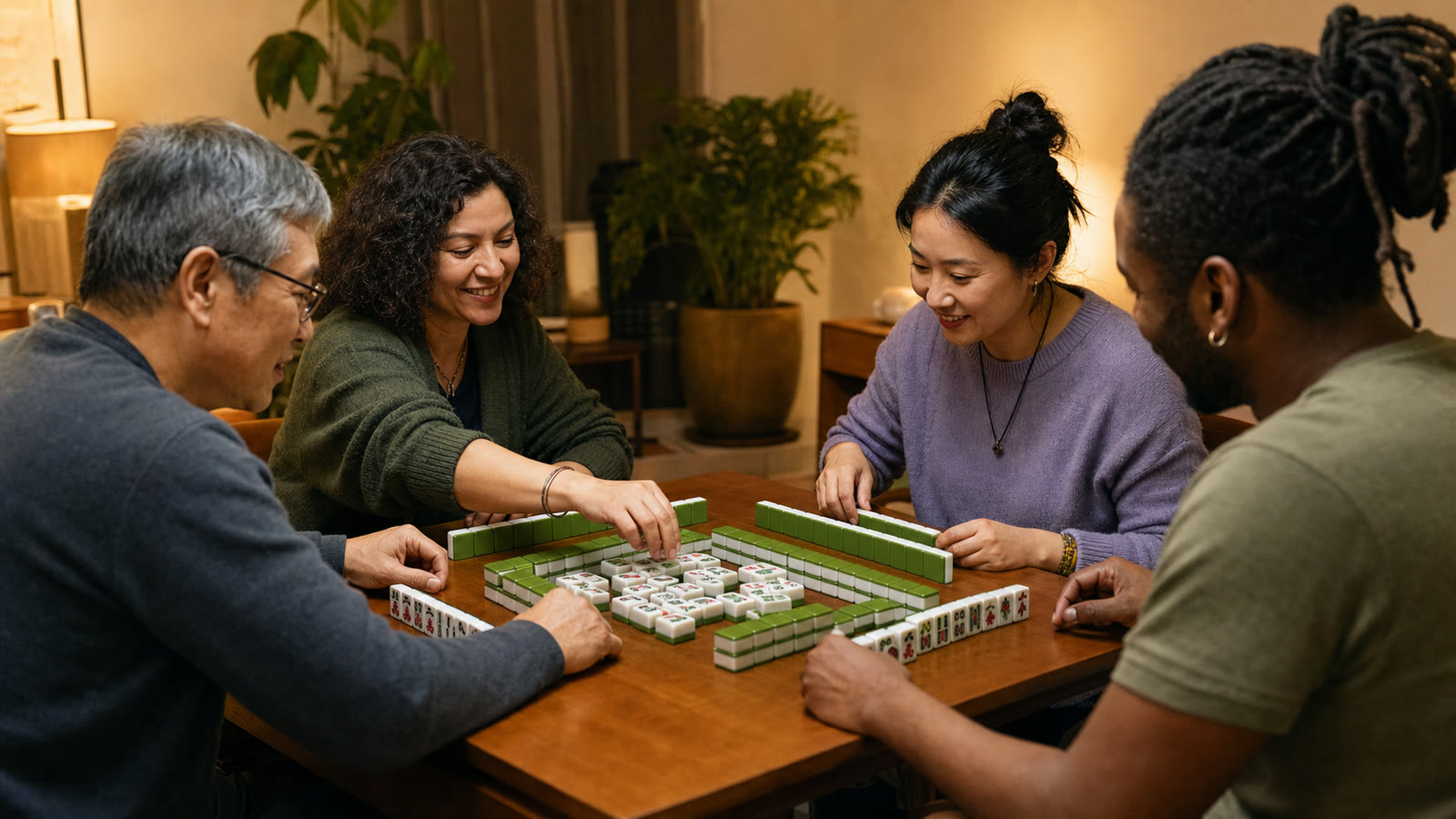
Host a beginner Mahjong night with clear rules, table setup, teaching flow, etiquette, rotation, next-step practice links, and pacing tips for guests.
Read this post, then follow the linked practice or community path.
The live app experience on tsumo follows the same route structure, ruleset labels, and practice surfaces linked below.
Blog focus
Read the latest Mahjong blog posts from tsumo.
Follow internal links to connect each post back to local clubs, puzzles, tutorials, and playable routes.
By tsumo Editorial. Published 2026-06-15, updated 2026-06-29. 8 minute read.
A beginner-friendly Mahjong night works when the host chooses one ruleset, controls pace, teaches table language, and protects the first hour from overload.
A successful Mahjong night is not measured by how many rules the host explains. It is measured by whether new players leave understanding the table rhythm, wanting another hand, and knowing what to practice next.
A beginner-friendly Mahjong night works when the host chooses one ruleset, controls pace, teaches table language, and protects the first hour from overload. It gives hosts a practical run-of-show for welcoming beginners without overwhelming them.
Official player materials, NMJL context, and current trend reporting support the hosting advice without pretending one variant covers every table.
Choose one ruleset for the room
Beginners cannot learn six variants at once, even if the host knows them. Choose the ruleset your group is most likely to keep playing and say what is out of scope for the first night.
Practice move: A clear boundary prevents friendly explanations from becoming a lecture.
Set up the table before guests arrive
Tiles, racks, dice, score aids, and a visible reference sheet should be ready before the first question.
Physical clarity reduces anxiety because players can copy the setup instead of asking where everything goes. Seat the most patient teacher where they can see the newest player.
Teach the first hand slowly
The first hand should prioritize turn order, drawing, discarding, and seeing groups before scoring complexity.
If a player can explain what a chow, pung, pair, or wait is, the night is already working. Delay rare edge cases until they happen naturally.
Control pace and table talk
New players need permission to think, but the table still needs a rhythm. Use a teaching table for explanations and a faster table for regulars if the group is large enough.
Practice move: Do not let experienced players solve every discard for the beginner.
Make the next session obvious
A single event becomes a group when players know where to practice, what rules were used, and when to return.
Send one follow-up link, one rules reminder, and one next date instead of a pile of resources. The goal is continuity, not content overload.
Practical Checklist
Pick one ruleset and announce it.
Prepare tiles, references, and seating.
Teach turn flow before scoring depth.
Rotate teachers instead of overwhelming one table.
Send the next practice step within a day.
Where to Go Next
Learn Mahjong online - Use the beginner learning path when a piece raises a rule, scoring, or table-flow question you want to practice.
Find a Mahjong club - Use the club locator to turn cultural context into an in-person table, teaching session, or local meetup.
Practical Applications
Two-Hour Beginner Agenda
A beginner night needs pacing more than decoration. For a two-hour session, spend the first 10 minutes on seating, variant choice, and what a completed hand looks like; 20 minutes on tiles, turns, and calls; 20 minutes on an open-hand practice round; 45 minutes on assisted play; 15 minutes on a reset break and questions; and the final 10 minutes on next steps. That agenda leaves room for mistakes without letting the evening dissolve into rule lecture.
Table setup: one rules card, one discard direction reminder, enough racks or tile space, and a visible place for flowers, dead wall, or jokers if your variant uses them.
Beginner table: open discussion is allowed, scoring is simplified, and the host pauses for teachable moments.
Regular table: experienced players play normally but agree not to overwhelm new players with exceptions.
Host role: seat people, pick the variant, explain correction style, and stop one confident player from dominating instruction.
Exit plan: send everyone home with the exact ruleset, a practice link, and the date of the next table.
Food and music matter only after the game loop is stable. Keep the table surface clean, avoid snacks that mark tiles, and put drinks on side tables. A comfortable room is one where players can hear calls, see discards, and ask a question without embarrassment.
If the group mixes American, Riichi, and Chinese-family backgrounds, choose one variant for the night and name it plainly. Hybrid teaching creates confusion unless everyone already understands the differences.
Failure Modes and Fixes
Most beginner Mahjong nights fail in predictable ways. The host teaches three variants at once, experienced players debate edge cases, the table surface is too crowded, scoring arrives before anyone understands the hand shape, or shy guests do not know whether they are allowed to ask questions. Each failure has a simple prevention: choose one variant, appoint one rules lead, clear the table, delay rare scoring, and announce that questions are welcome during teaching rounds.
A good host also manages social energy. Mahjong can be intense for new players because every discard feels public. Build in a pause after the first practice hand so guests can reset, ask about tile names, and change seats if one teacher is overwhelming them. The goal is not to finish as many hands as possible; it is to make guests willing to return.
Send a pre-event note with the variant, start time, parking or transit, food expectations, and whether complete beginners are welcome.
Put a small rules card at each seat so players do not have to interrupt for every term.
End with one shared review question: what rule should we explain better next time?
Materials and Room Layout
A host can solve many beginner problems before guests arrive. Put the rules card where every seat can see it. Keep discards centered and visible. Place snacks away from tiles. Use a side table for drinks. Leave enough elbow room that players can build a hand without knocking over another rack. These details sound small, but they determine whether beginners can focus on the game loop.
The host should also choose a correction policy. During the first open-hand practice round, coaching can be active. During later hands, coaching should be limited to rules and procedure unless the table explicitly remains in teaching mode. That boundary keeps experienced helpers from playing four hands at once.
Print or share the exact variant name; do not advertise simply as Mahjong if several rule families are possible.
Seat one patient regular at the beginner table, not necessarily the strongest player in the room.
Use a timer for the first explanation so the night does not become a seminar before anyone touches tiles.
Teaching Load Management
A successful host needs to talk about teaching load. One experienced player can explain rules, watch four hands, answer scoring questions, manage snacks, and welcome late arrivals for about ten minutes before quality drops. A better beginner night assigns jobs. One person welcomes and seats guests, one explains the active variant, one watches the beginner table, and one keeps the regular table moving. Small groups can still do this by naming roles informally. The point is to prevent every question from flowing to the loudest expert. A printed rule sheet or table tent can absorb routine questions without stopping every hand. Hosts should also stop before guests are exhausted. Ending with a next date and one remembered lesson is better than pushing through another confusing hand that makes beginners feel they failed.
Source Notes and Limits
The cited sources use official player materials, National Mah Jongg League context, and current trend coverage for social play and at-home game nights.
Hosting advice is operational rather than universal. The agenda should be adapted for American Mah Jongg, Riichi, MCR, Taiwanese, or family rules before guests arrive.
Quick FAQ
What is the biggest beginner-night mistake? Trying to teach every exception before players understand the turn loop and what a completed hand looks like.
Should beginners and regulars share a table? They can, but a separate beginner table with explicit teaching permission usually creates a better first experience.
What should guests receive afterward? Send the exact variant name, a practice link, a short rules reference, and the next date while the game is still fresh.
tsumo Editorial — tsumo Editorial is the organizational byline for source-backed Mahjong guides and articles published by tsumo. The team checks rules explanations against implemented app behavior and maintains corrections through the public contact process.
 tsumo
tsumo