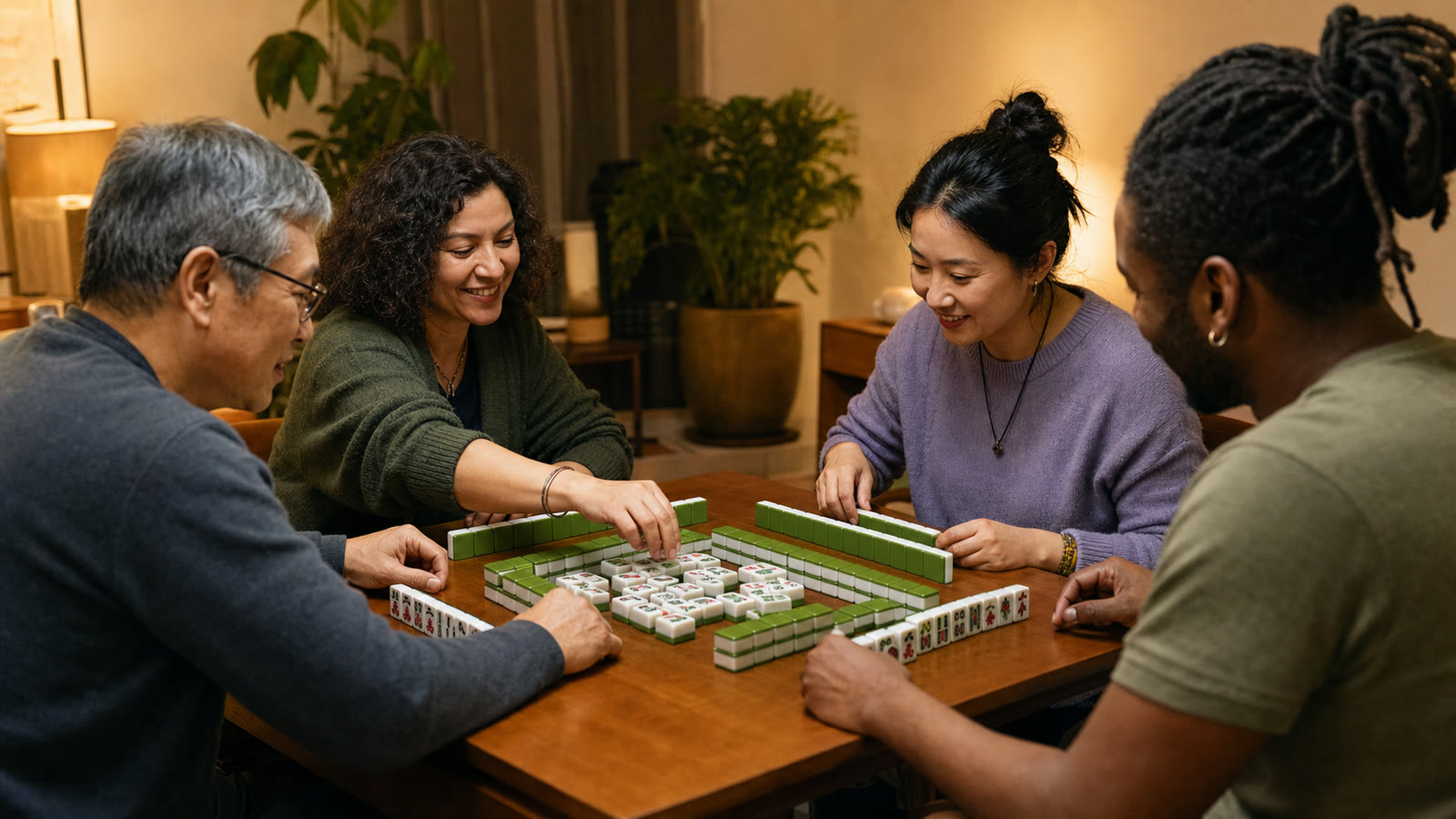
See why Gen Z players are returning to Mahjong through online apps, anime, cultural reclamation, local clubs, offline social play, and design.
Read this post, then follow the linked practice or community path.
The live app experience on tsumo follows the same route structure, ruleset labels, and practice surfaces linked below.
Blog focus
Read the latest Mahjong blog posts from tsumo.
Follow internal links to connect each post back to local clubs, puzzles, tutorials, and playable routes.
By tsumo Editorial. Published 2026-06-28, updated 2026-06-29. 8 minute read.
Younger players are finding Mahjong through family reclamation, anime and online clients, aesthetic sets, club pop-ups, and a hunger for offline social games.
The new Mahjong audience is not discovering a brand-new game. It is rediscovering a table that can be social, beautiful, competitive, cultural, and offline at a time when many leisure habits are screen-heavy.
Younger players are finding Mahjong through family reclamation, anime and online clients, aesthetic sets, club pop-ups, and a hunger for offline social games. It separates documented trend visibility from assumptions about why younger players are showing up.
Smithsonian and Yelp trend coverage support visibility claims, while organization sources keep rules and league references grounded.
Digital discovery lowers the barrier
Online clients, short videos, and anime make Mahjong visible to players who might not have a local teacher. Visibility is not mastery, but it gives curious players a first vocabulary and a reason to search for rules.
Practice move: Convert curiosity into practice before the trend energy fades.
Cultural reclamation and family tables
For some younger Asian diaspora players, Mahjong is a way to reconnect with family memory and language.
For others, it is simply a compelling game that carries cultural context worth respecting. A good beginner space allows both routes without forcing one identity story onto everyone.
Aesthetic sets and tactile play
Tiles photograph well, sound satisfying, and make the table feel like an event.
That design appeal helps Mahjong compete with other social hobbies, but aesthetics alone do not teach etiquette or rules. Use the beautiful set as the invitation and the rules guide as the bridge.
Clubs replace one-off parties
A pop-up night becomes durable when organizers create regular dates, beginner tables, and clear expectations. Gen Z growth is strongest when discovery is attached to a place to return.
Practice move: If your group has demand, publish a schedule before buying more equipment.
The opportunity for teachers
Younger players are often comfortable learning from mixed media: video, apps, written guides, and live coaching.
That makes Mahjong easier to teach if the path is sequenced carefully. Start with one ruleset, one table habit, and one next practice action.
Practical Checklist
Choose a ruleset before inviting a crowd.
Create beginner and returning-player tables.
Use social media for scheduling, not just aesthetics.
Credit the tradition behind the game.
Send practice links after the event.
Where to Go Next
Find a Mahjong club - Use the club locator to turn cultural context into an in-person table, teaching session, or local meetup.
Learn Mahjong online - Use the beginner learning path when a piece raises a rule, scoring, or table-flow question you want to practice.
Practical Applications
What Is Sourced and What Is Inferred
The evidence supports a broad revival in Western lifestyle coverage, social clubs, home-game interest, and online discovery. It does not prove a single Gen Z motive. Some younger players are drawn by design, some by family reconnection, some by low-pressure social routine, some by content creators, and some by the simple fact that a four-player game gives friends a reason to meet without another screen-centered hangout.
Sourced: trend coverage documents renewed attention to Mahjong in homes, culture pages, and lifestyle reporting.
Sourced: official league and club sources show organized play remains variant-specific and rules-dependent.
Inferred: younger players may value the mix of tactile ritual and social structure, but the motive varies by group.
Unsupported if overstated: claims that an entire generation is reviving Mahjong for one identity, wellness, or aesthetic reason.
A stronger trend reading treats Gen Z as a discovery channel, not a monolith. The same club may include heritage learners, anime and Riichi fans, American Mah Jongg beginners, design-conscious hosts, and serious competitors. The common product is recurring table time, not a single cultural explanation.
For organizers, the trend lesson is operational. Make signups easy, explain the variant, photograph real tables with permission, and offer a next date. Style can attract first attendance, but a clear teaching path creates the second visit.
From Aesthetic Interest to Repeat Play
A trend guidance becomes more useful when it distinguishes attraction from retention. Aesthetic tile sets, social videos, and cafe events can bring younger players to the first table. Repeat play usually depends on less glamorous details: a patient teacher, a clear variant, a welcoming correction style, and a next session that is easy to join.
That distinction also keeps the advice from overclaiming. Lifestyle coverage can document visibility, but it cannot prove that every new player is motivated by heritage, wellness, nostalgia, or fashion. A strong trend discussion uses trend sources to show Mahjong being noticed, then uses club and rules sources to explain what players need after noticing it.
For creators, show real play and credit the variant instead of using tiles only as background texture.
For clubs, convert interest into a calendar, beginner table, and rules link.
For brands, avoid implying that Mahjong is newly invented because a younger audience discovered it.
For writers, mark generational motives as reported or inferred, not universal.
Content and Community Ethics
When Mahjong becomes trend content, writers and creators have responsibilities. They should credit the communities that kept the game alive, name the variant being shown, avoid presenting expensive sets as the entry requirement, and make room for older players whose knowledge is not packaged for social media. Trend attention can widen the table, but it can also erase the people who were already seated there.
For younger organizers, the practical ethics are simple. Invite elders or experienced players as teachers if they want that role, compensate venues fairly, ask before filming, and do not shame players who use different terminology. A club can be stylish and still be humble about inheritance.
This advice can also help brands and lifestyle writers avoid weak claims. It is fair to say Mahjong is receiving renewed attention in some Western social circles. It is not fair to imply that young players rescued a dormant game, that one aesthetic explains all interest, or that buying a premium set equals cultural participation.
Sustainable Trend Coverage
Sustainable trend coverage should follow the player after the first photo. Did they find a rules path? Did they meet patient teachers? Did the group explain cost and variant? Did the event offer a next table? These questions matter more than whether Mahjong looks good in a lifestyle spread, because a trend only becomes a revival when people keep playing.
From Visibility to Stewardship
A Gen Z trend discussion is strongest when it ends with stewardship rather than novelty. Younger players may bring photography, event design, social video, and new club energy, but the game was not waiting to be discovered. Families, immigrant communities, American Mah Jongg groups, Riichi clubs, tournament organizers, and online players kept Mahjong alive in different ways. Trend coverage is useful when it widens access and weak when it erases those continuities. Readers should younger hosts to credit teachers, name variants, avoid filming without consent, and keep prices or aesthetics from becoming a gate. That is how trend attention turns into a larger table instead of a short-lived style moment.
That stewardship lens also protects the advice from treating style as substance. Beautiful sets and social posts can invite curiosity, but recurring tables, patient teaching, and respect for existing communities are what turn curiosity into lasting participation.
Source Notes and Limits
The cited sources use Smithsonian and Yelp trend coverage for current cultural attention, plus official organization sources to keep rules and league context grounded.
Generational motives are treated as inferred and plural. This analysis avoids claiming that all younger players share the same identity, wellness, nostalgia, or aesthetic reason for playing.
Quick FAQ
Is Gen Z reviving Mahjong for one reason? No. The sources support renewed attention, but motives vary across heritage, design, social routine, online discovery, and competition.
What turns trend interest into a lasting club? Clear variant labeling, easy signups, beginner onboarding, consistent dates, and real table photos with consent.
What claims should writers avoid? Avoid treating a whole generation as one audience or using trend coverage as proof of medical, cultural, or identity outcomes.
tsumo Editorial — tsumo Editorial is the organizational byline for source-backed Mahjong guides and articles published by tsumo. The team checks rules explanations against implemented app behavior and maintains corrections through the public contact process.
 tsumo
tsumo