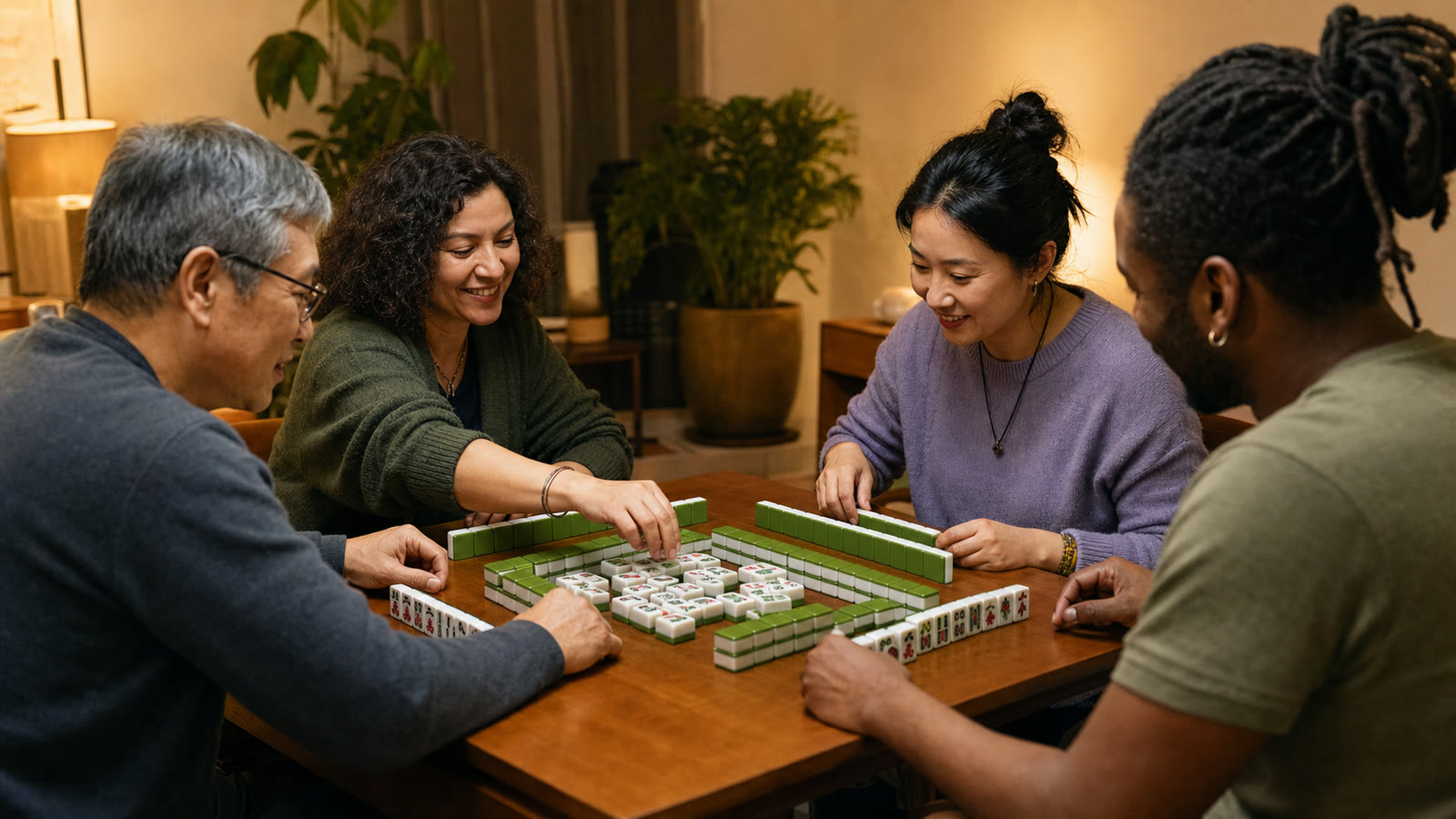
Review Mahjong social benefits with cautious research-backed language about connection, routine, cognitive engagement, community, and belonging.
Read this post, then follow the linked practice or community path.
The live app experience on tsumo follows the same route structure, ruleset labels, and practice surfaces linked below.
Blog focus
Read the latest Mahjong blog posts from tsumo.
Follow internal links to connect each post back to local clubs, puzzles, tutorials, and playable routes.
By tsumo Editorial. Published 2026-06-29, updated 2026-06-29. 10 minute read.
Mahjong can support social connection, routine, attention, and intergenerational play, but health claims should stay evidence-based and cautious.
Mahjong is often described as good for the brain or good for loneliness. A careful guide is more precise: Mahjong creates structured social contact, memory work, attention, turn-taking, and shared routine. Those qualities are valuable, but they are not a substitute for medical care.
Mahjong can support social connection, routine, attention, and intergenerational play, but health claims should stay evidence-based and cautious. It keeps social-benefit claims useful and cautious by separating research evidence from club experience.
PubMed-indexed studies and cultural sources support cautious distinctions between observed associations and community experience.
Connection is the clearest benefit
Mahjong gives people a reason to sit together repeatedly, learn shared language, and recognize each other across weeks or years. That regularity is especially important for clubs, seniors, immigrants, and players seeking offline community.
Practice move: The strongest claim is social engagement, not guaranteed health outcome.
Cognitive engagement is real but nuanced
The game asks players to remember discards, track suits, compare probabilities, and adjust plans.
Research can study associations with cognition, but individual benefit depends on context, frequency, and many other factors. Describe Mahjong as cognitively engaging rather than as a treatment.
Intergenerational play has special value
A Mahjong table can let grandparents, parents, students, and friends share a skill without needing the same media habits.
The tiles create a common activity where teaching and storytelling happen naturally. Clubs should design beginner sessions that make this bridge easier.
Routine supports belonging
Weekly tables reduce the friction of social planning because the next gathering is already expected. That routine can matter as much as the game itself.
Practice move: A community benefit grows when organizers protect consistency.
Digital-to-local pathways
Online practice can help nervous beginners learn flow before attending a club.
Local tables then add etiquette, conversation, and trust that software cannot fully reproduce. Use digital tools as preparation for human contact, not as proof that community has been solved.
How to write responsibly about health
Avoid claims that Mahjong prevents, treats, or cures cognitive decline, depression, or loneliness unless a source directly supports that claim.
Even then, summarize the study design and limitation rather than turning one finding into universal advice. Responsible writing builds trust with readers and publishers.
Practical Checklist
Use association language for research findings.
Separate social benefit from medical treatment.
Name the table routine, not only the game.
Design beginner-friendly local pathways.
Encourage professional help for health concerns.
Where to Go Next
Find a Mahjong club - Use the club locator to turn cultural context into an in-person table, teaching session, or local meetup.
Learn Mahjong online - Use the beginner learning path when a piece raises a rule, scoring, or table-flow question you want to practice.
Practice Mahjong decisions - Daily puzzles are the fastest way to turn guidance advice into repeatable tile-reading decisions.
Practical Applications
Study-Design Caveats
Social-benefit claims work best when they distinguish three evidence levels. Mahjong-specific studies can support claims about observed associations in studied populations. Broader social-activity research can support the idea that structured group activity may matter, but it is not Mahjong-specific proof. Club anecdotes can illustrate why people return, but they should not be written as medical evidence.
Mahjong-specific evidence: cite the study design, population, measured outcome, and whether the finding is association rather than treatment effect.
Broader evidence: use it for context about social engagement, routine, and cognitive activity without implying the game alone caused an outcome.
Community evidence: describe companionship, intergenerational contact, and recurring attendance as lived benefits, not clinical claims.
Language guardrail: prefer may be associated with, can provide, and has been observed over prevents, treats, or cures.
A practical example is a weekly club that gives older adults a recurring appointment, younger players a low-pressure intergenerational space, and immigrants or heritage learners a reason to use familiar language. Those outcomes are meaningful even without overstating them as medical treatment.
The best next step for readers is social rather than clinical: find a table with clear rules, consistent scheduling, and a host who welcomes beginners. The health-adjacent research belongs in the background; the table experience belongs in the foreground.
What Social Benefit Looks Like in Practice
The strongest social-benefit claims are the ones a reader can observe without overstating the science. A recurring Mahjong table gives people a scheduled place to go, a shared task, light competition, reasons to speak across age groups, and enough structure that conversation does not have to carry the whole gathering. Those are meaningful social conditions even before anyone discusses health outcomes.
Peer-reviewed studies can help frame why structured activity and social participation may matter, but the language should be explicit about study limits. Population, comparison group, frequency of play, outcome measure, and study design all affect what can be said. A cross-sectional association is not the same as proof that Mahjong caused a result. A small or context-specific study should not become a universal promise.
The practical section should therefore give organizers language they can safely use. Say the club offers routine, companionship, learning, and a welcoming table. Say some research has examined Mahjong or social activity in relation to cognitive or mental-health outcomes. Do not say the club treats loneliness, prevents dementia, or replaces professional care.
For individuals, choose a table that is consistent enough to become part of a weekly routine.
For hosts, build beginner support so social benefit is not limited to people who already know the game.
For families, use Mahjong as a shared activity rather than a test of who remembers every rule.
For writers, keep research claims tied to the exact population and outcome studied.
Evidence Ladder for Social Claims
Readers should use an evidence ladder. At the bottom are anecdotes: a player made friends, a family reconnected, a club felt welcoming. These are valuable stories but not general proof. In the middle are observational studies that measure associations between Mahjong, social engagement, cognition, mood, or related outcomes in defined populations. At the top would be stronger intervention evidence, which should not be implied unless a cited study actually supports it.
This ladder makes the writing more trustworthy. A sentence can say, players often describe Mahjong as a source of routine and companionship, based on community experience. A different sentence can say, peer-reviewed studies have examined associations between Mahjong participation and selected health or social outcomes in specific populations. Those are not the same claim, and readers should be able to tell the difference.
The evidence ladder keeps agency with the reader. Mahjong is a promising social activity for many people because it combines rules, conversation, memory, and recurring appointments. It is not the right environment for everyone. Noise, competition, gambling associations, or correction style can make some tables stressful. A good guide helps readers choose a table that fits their needs.
Strong club language: recurring social play, structured engagement, shared learning, and intergenerational contact.
Careful research language: associated with, observed in, studied among, or may support.
Avoided language: cures, prevents, guarantees, clinically treats, or works for everyone.
How to Apply Research Without Overclaiming
The safest application of research is to design better tables. If studies and community reports suggest that structured social activity can matter, organizers can make the structure stronger: consistent schedules, clear rules, welcoming correction, accessible venues, and opportunities for players to contribute. Those actions are useful even when the advice avoids medical promises.
The advice also helps readers evaluate their own experience. A table that creates anxiety, exclusion, financial pressure, or constant embarrassment is not socially beneficial just because Mahjong is involved. The benefit comes from the interaction between game, host, room, and player needs. That nuance makes the piece more honest and more actionable.
For families, the application is simple: use Mahjong as a shared ritual, not a performance test. Let experienced players tell stories, let beginners ask questions, and agree on the rules before competition becomes serious. Social benefit is often built in the small procedures around the table.
Social Fit Note
Social benefit depends on fit. A quiet learner may need a patient teaching table; a competitive player may need a club with clear tournament lanes; an older beginner may need accessible space and steady pacing. Treat the right table as a design question, not an automatic result of the game itself.
Careful wording can still be warm. Caution about research does not weaken the social case for Mahjong; it makes the invitation more trustworthy because readers know exactly what the evidence can support and what the host is promising.
Designing for Belonging
Social-benefit guidance translates caution into design. If the safe claim is that Mahjong can provide structured social engagement, then hosts should strengthen the structure: predictable dates, clear rules, beginner welcome, accessible venues, and correction norms that do not embarrass people. If the safe claim is that some studies examine associations in specific populations, then writers should name the population and avoid universal promises. This is not timid writing; it is useful writing. Readers can act on it. They can choose a table that fits their needs, or build one that offers routine and companionship without pretending to be medical care. That balance makes the advice credible and humane.
That nuance is the reason the invitation can be both careful and inviting. It encourages readers to seek tables that are welcoming, consistent, and well run, while leaving clinical claims to studies designed to test them.
Source Notes and Limits
The cited sources include peer-reviewed PubMed-indexed studies for health-adjacent claims and cultural or trend sources for the modern social context.
Benefits are framed as observed associations, structured engagement, and community experience. The evidence summary does not claim that Mahjong prevents, treats, or cures medical conditions.
Quick FAQ
What can research safely say? It can support studied associations and context for social engagement, but it should not be rewritten as treatment or prevention language.
What benefits can a club describe directly? A club can describe routine, companionship, intergenerational contact, learning, and a welcoming place to return.
What should readers do next? Find a clearly hosted table, confirm the variant, and choose a group that treats beginners and corrections with care.
tsumo Editorial — tsumo Editorial is the organizational byline for source-backed Mahjong guides and articles published by tsumo. The team checks rules explanations against implemented app behavior and maintains corrections through the public contact process.
 tsumo
tsumo