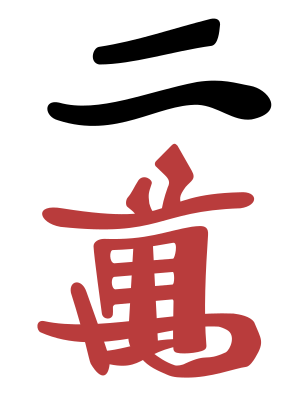
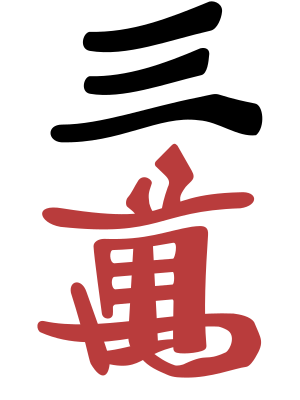
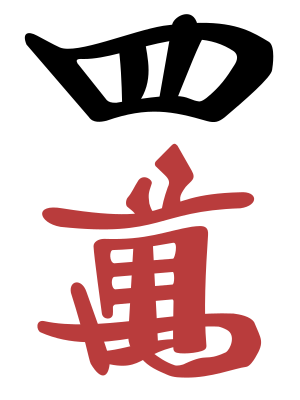
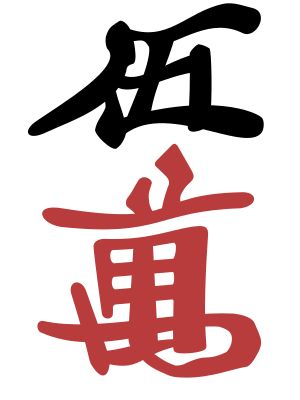
Learn Riichi Mahjong online with Japanese Mahjong rules, yaku requirements, riichi timing, dora vs yaku, furiten, defense, and interactive tutorials.
Focus on the variant-specific legality and scoring gates that change whether a complete shape can actually win.
The live app experience on tsumo follows the same route structure, ruleset labels, and practice surfaces linked below.
Riichi Mahjong Rules answer
Riichi Mahjong Rules on tsumo explain the legal hand structure, claim timing, and scoring gate for Riichi Mahjong.
Use this page to learn the rule checks before you play Riichi Mahjong online in the browser.
Riichi Mahjong uses 4 sets plus 1 pair with yaku eligibility and emphasizes yaku, dora, furiten, and riichi timing.
Riichi Mahjong practice path
Read the Riichi Mahjong rules page, run the matching tutorial, then use puzzles or bot games to repeat the same decisions.
The tutorial route mirrors the playable Riichi Mahjong mode so answer content, practice flow, and game behavior stay aligned.
Review one rule failure at a time: hand shape, eligibility gate, claim priority, then scoring value.
How to study this ruleset
Learn the minimum win requirement first so complete-looking hands do not fail unexpectedly.
Practice claim timing and turn-order priority because those decisions change legal options.
Move from tutorial repetition to bot games only after you can explain why a hand is valid.
Riichi Mahjong Rules (Japanese Mahjong)
By tsumo Editorial Team. Reviewed against the live rules engine and tutorial flows.
A fully standalone beginner Riichi lesson covering yaku, han, dora, fu, riichi timing, furiten, and first-game attack-versus-defense decisions.
Riichi is the mode where legality, timing, and discipline matter most. You still build a complete hand, but the hand is not winnable unless it has at least one yaku. Dora adds bonus value after a yaku exists, not before. Riichi can be declared only from a legal ready hand and locks your hand shape, while furiten can block ron if your discard history overlaps your winning tiles. A new player should think yaku first, dora second, and safety always.
Dora adds han but never creates legality by itself
Important Extra Rule
Furiten can block ron even when the shape is complete
What This Mode Is
Riichi is the most tactical of the four beginner routes because it cares deeply about what your hand is worth, when you commit, and whether the table has become dangerous.
A first-time Riichi player needs two habits immediately: always ask what the yaku is, and never assume bonus value is the same as win legality.
A complete hand still needs at least one yaku to win.
Dora is helpful, but dora alone does not make the hand live.
Riichi is a powerful declaration, not a button you press automatically.
Defense becomes a real skill much earlier in this mode.
Why This Mode Feels Different
Riichi punishes vague thinking. A hand can look beautiful, hold several bonus tiles, and still be dead if it has no yaku. It can also be one tile from victory and still be a bad riichi because the wait is poor and the table is dangerous.
That is why Riichi feels more precise than the other modes. You are not only building a hand. You are choosing a legal scoring route and timing your commitment.
Yaku decides whether the hand can win at all.
Han and fu shape the final payout after the hand is already legal.
Riichi locks the hand shape after declaration.
Furiten means your own discard history can shut off ron.
Before You Start
You can learn Riichi from zero, but it helps to carry over one stable base idea from the earlier modes: a normal winning hand is still usually four groups and one pair.
What changes here is the extra rules language. Learn these four terms early: yaku, han, dora, and fu.
Yaku is the scoring pattern that makes the hand winnable.
Han is the value you count after the hand already has a yaku.
Dora is bonus han. It boosts a legal hand, but it never creates legality.
Fu is the structure-based value used in the final point calculation.
Tiles and Table Setup
Riichi uses the 136-tile set with suits and honors only. There are no flowers, but the table does show dora indicators from the dead wall.
Those indicators matter because they point to bonus tiles. They do not, however, change the basic legality rule: the hand still needs a yaku first.
Players start with the standard 13 tiles, with the dealer holding 14 before the first discard.
Dora indicators are public and affect bonus value only.
Kans can create additional indicators and change the table value picture.
No flower replacement flow exists in Riichi.
How a Turn Works in This Mode
The ordinary draw-discard loop is still here, but every draw should also be checked against your yaku plan and the danger level at the table.
As the hand gets closer, you may reach tenpai, which means the hand is one tile away from winning. If the hand is closed and the other conditions are right, that is where the riichi decision enters.
Draw one tile and ask whether it improves your yaku route, your wait quality, or your safety.
Discard the tile that hurts those goals the least.
When the hand reaches a legal ready state, decide whether riichi is actually good here.
After riichi, the hand shape is locked and the focus shifts to live tiles and danger.
The hand ends by ron, tsumo, or exhaustive draw settlement.
Claims and Call Priority
Claims still work through chi, pon, kan, ron, and tsumo, but Riichi makes claims more delicate because opening the hand can remove important yaku options.
A beginner should assume that an open call needs a clear reason. If you do not know what yaku survives after the call, treat the call as suspicious.
Chi is left-player only, while Pon and Kan can come from any player when legal.
Ron can be blocked by furiten even if the hand looks complete.
Open calls can remove some easy closed-hand plans, including riichi itself.
Use open calls only when they clearly preserve a legal yaku route.
How to Build a Hand
The cleanest beginner Riichi hands start from a simple yaku plan. Tanyao, Yakuhai, or a straightforward riichi route are much easier to manage than a hand with no named plan at all.
As the hand develops, keep asking which tiles preserve a legal route and which tiles only preserve dora or pretty shape.
Choose one likely yaku route by the early-middle turns.
Keep the hand closed when your easiest route depends on riichi.
Treat dora as a value amplifier after the yaku is secure.
Good waits matter because weak waits make both riichi and late pushes worse.
How to Tell If You Can Win
Riichi requires a complete hand plus at least one yaku. That is the core legality test. Dora does not replace yaku, and furiten can still stop ron even when the hand is otherwise complete.
This is the section to slow down on. Most early Riichi mistakes come from confusing bonus value with legal value or forgetting that furiten changes the claim options.
First confirm the hand is structurally complete.
Then name the active yaku out loud or mentally.
If you cannot name a yaku, the hand cannot win yet.
Check furiten before ron. If furiten applies, ron is blocked and you must pivot.
How Scoring Works in This Mode
Riichi scoring has four layers that matter to beginners: yaku makes the hand legal, han measures value, fu shapes the final calculation, and dora adds bonus han after legality is already settled.
You do not need to master every final point calculation on day one. You do need to understand which layer answers which question.
Yaku answers: can this hand win at all?
Han answers: how much value does the hand have once it is legal?
Fu answers: how does the hand structure affect the final payout?
Dora answers: how much bonus value gets added after the hand is already live?
Your First Hand in This Mode
The safest first Riichi hand is one where you pick a simple yaku route early and refuse to be distracted by dora until the route is real.
Do not try to play like an expert immediately. Your first goal is not perfect aggression. It is correct legality checks and sane riichi timing.
Turn 1: Sort the hand into likely yaku routes, connected shapes, and isolated leftovers.
Turn 2: Decide whether the hand looks more like a closed riichi route, a tanyao route, or a yakuhai route.
Turn 3: Keep tiles that support that route and discard tiles that only look nice without helping legality.
Turn 4: If the hand is still flexible, keep it closed and clean rather than forcing an early open call.
Beginner Strategy Playbook
Strong beginner Riichi play comes from discipline, not bravery. Pick a legal route, keep the hand honest, and avoid confusing pressure with strength.
Commit to one likely yaku route by the early middle of the hand.
Keep the hand closed when riichi is your easiest path.
Treat dora as extra value after legality is secure.
Declare riichi selectively, not automatically.
If the hand is weak and the table is hot, fold early rather than late.
Defense and Risk Management
Riichi rewards defense more than the earlier modes. A player who keeps pushing without a good wait or a clean legal route will donate points quickly.
The hardest beginner lesson is often learning that folding is not failure. It is correct play when the attack is weak.
When someone is in riichi, re-evaluate every discard as a danger choice.
Use visible discards and table rhythm to find safer exits.
If your hand is not clearly live, stop paying for it with dangerous tiles.
Weak waits and weak legality are both reasons to step back.
Worked Scenarios
Basic Scenario: Dora But No Yaku
Setup: The hand is complete and holds dora, but there is no active yaku.
Objective: Recognize that the hand is still not winnable.
Confirm the hand shape is complete.
Look for the actual yaku and notice that none exists.
Refuse the win call and keep playing for a legal route.
Prefer discards that preserve the easiest yaku path now.
Expected outcome: You stop turning bonus value into false certainty.
Dora is never the answer to the legality question.
Mid Scenario: Furiten Blocks Ron
Setup: A winning tile appears, but you have already discarded that same tile earlier.
Objective: Spot the furiten issue before you claim ron.
Check your discard line when the wait changes or a winning tile appears.
Notice that the winning tile overlaps with your own discard history.
Recognize that ron is blocked under furiten.
Switch to tsumo or a safer plan instead of forcing the claim.

Expected outcome: You avoid invalid ron attempts and make cleaner endgame choices.
A live-looking tile is not claimable by ron if furiten says no.
Advanced Scenario: When Riichi Is A Mistake
Setup: You are in tenpai, but the wait is thin and the table already looks dangerous.
Objective: Decide whether the declaration is actually worth the commitment.
Measure the strength of the wait and how many winning tiles are still live.
Check whether opponents are already showing danger.
Compare the upside of riichi to the downside of locking a weak line.
Choose patience or defense if the declaration adds pressure without real quality.
Expected outcome: Riichi becomes a decision instead of a reflex.
A bad riichi is still bad even when it is technically legal.
What Beginners Usually Misunderstand
Dora is not a substitute for yaku
New Riichi players often see bonus tiles and assume the hand can win. It cannot. Yaku decides legality, not dora.
Fix: Name the yaku before you ever count the dora.
Riichi is not always the right button
A legal riichi can still be a bad riichi if the wait is weak or the table danger is too high.
Fix: Check wait quality and table risk before every declaration.
Furiten changes what kind of win is possible
A hand can be structurally ready and still lose the right to ron if your own discards overlap the wait.
Fix: Scan your discard history whenever the winning tile changes.
Common Mistakes and Fixes
Trying to win with dora and no yaku. - Run a yaku check before every win call.
Declaring riichi on weak waits. - Require both a legal hand and a respectable wait before you commit.
Ignoring furiten until the claim moment. - Check your discard line the moment the wait changes.
Opening the hand without knowing the surviving yaku. - Assume an open call is bad until you can explain the legal route afterward.
Practice Drills
Drill 1: Yaku First
Goal: Remove no-yaku mistakes from your game.
Before every win attempt, say the yaku to yourself.
If you cannot name one, do not call the win.
Review which hands became legal and when.
Success check: You complete a session with no no-yaku win attempts.
Drill 2: Dora Reality Check
Goal: Separate bonus value from legality.
When you see dora, ask whether the hand already has yaku.
If the answer is no, treat the dora as future upside, not present legality.
Write down one hand where this changed your decision.
Success check: Dora no longer triggers false win confidence.
Drill 3: Furiten Audit
Goal: Make furiten awareness automatic.
Every time the hand reaches a ready state, scan your own discards.
Mark whether ron is live or blocked.
If blocked, switch mentally to tsumo or defense.
Success check: You go multiple matches without a furiten misclaim.
Drill 4: Riichi Filter
Goal: Improve declaration quality.
Before riichi, ask whether the wait is strong and whether the table is safe enough.
Skip one tempting but weak riichi each session.
Compare the results of disciplined and impulsive declarations.
Success check: Your riichi decisions have clear reasons, not just speed.
Drill 5: Push-Fold Review
Goal: Build late-hand discipline.
From the late turns onward, label every choice as push or fold.
Write one sentence about why the choice was right or wrong.
Use those notes in the next session.
Success check: Late-hand decisions become easier to explain and less emotional.
Ready-to-Play Checklist
I know that every legal Riichi win needs at least one yaku.
I know that dora adds value but does not create legality.
I know that furiten can block ron.
I know that riichi locks the hand shape and should not be declared blindly.
Mode FAQ
Can I win with dora but no yaku?
No. Dora is bonus han only. The hand still needs at least one yaku.
What is the easiest beginner yaku to look for?
Simple, recognizable routes like tanyao, yakuhai, or a clean closed riichi plan are usually the best place to start.
Do I have to declare riichi whenever I can?
No. Riichi is optional and should depend on wait quality and table danger.
What should I check before calling ron?
Check both the yaku and whether furiten blocks the claim.
Learn Riichi Mahjong online with Japanese Mahjong rules, yaku requirements, riichi timing, dora vs yaku, furiten, defense, and interactive tutorials. This static route summary is written to be useful before the interactive client loads: it states the question, the practice path, and the next action a Mahjong learner can take on the same site.
Last reviewed: 2026-05-05. Review cadence: monthly.
Search Intents Covered
riichi mahjong rules - answered with route-specific examples, practice links, and rule checks.
japanese mahjong rules - answered with route-specific examples, practice links, and rule checks.
riichi yaku requirement - answered with route-specific examples, practice links, and rule checks.
riichi furiten dora - answered with route-specific examples, practice links, and rule checks.
play riichi mahjong online - answered with route-specific examples, practice links, and rule checks.
Questions Answered
What is the biggest Riichi mistake?
Why is ron blocked sometimes?
Can I play Riichi Mahjong online on tsumo.io?
Questions This Page Answers
What is the biggest Riichi mistake?
Why is ron blocked sometimes?
Can I play Riichi Mahjong online on tsumo.io?
This static prerender keeps route-specific metadata and readable HTML available during deployment builds. The full interactive experience loads from the same route once the client bundle starts.