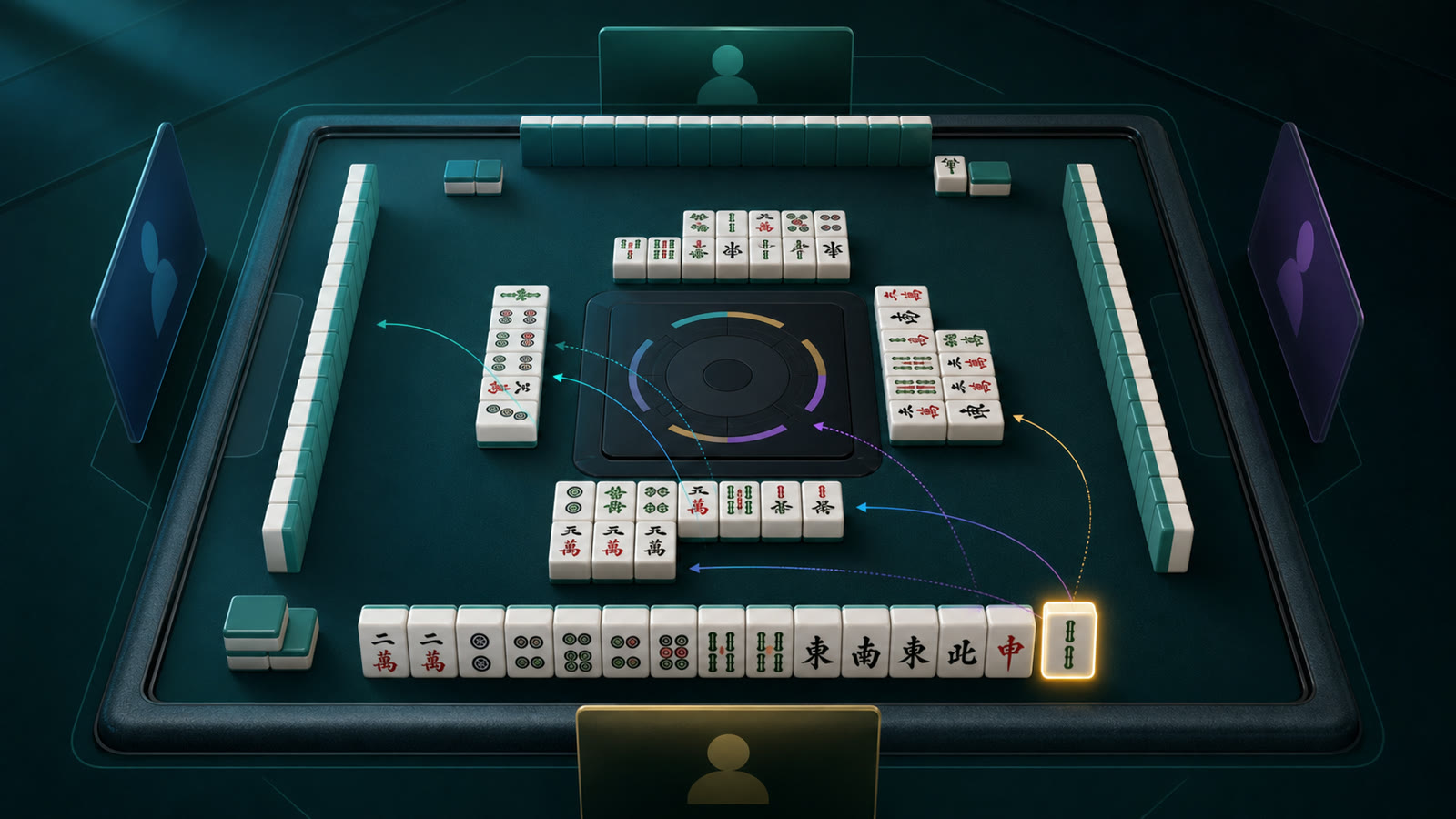
Learn how Mahjong teaches probability through tile acceptance, live tiles, expected value, risk, memory, practical review habits, and defense.
Read this post, then follow the linked practice or community path.
The live app experience on tsumo follows the same route structure, ruleset labels, and practice surfaces linked below.
Blog focus
Read the latest Mahjong blog posts from tsumo.
Follow internal links to connect each post back to local clubs, puzzles, tutorials, and playable routes.
By tsumo Editorial. Published 2026-06-29, updated 2026-06-29. 10 minute read.
Mahjong teaches applied probability because every discard asks players to weigh hidden information, improving tiles, score value, and risk.
Mahjong teaches probability because players must make decisions with incomplete information. You count visible tiles, infer what remains, weigh value against danger, and revise the plan every time the table changes.
Mahjong teaches applied probability because every discard asks players to weigh hidden information, improving tiles, score value, and risk. It shows how live tiles, visible evidence, and score context turn probability into table judgment.
Riichi study material, AI research, and peer-reviewed context support the probability examples without making medical or cognitive guarantees.
Tile acceptance is applied counting
Ukeire turns a vague feeling of closeness into a count of tiles that improve the hand. The count is simple enough to learn but rich enough to change with every draw and discard.
Practice move: Practice by comparing two discard candidates and naming the improving tiles for each.
Visible tiles change the denominator
A wait that looks strong in theory may be weak if many copies are visible in discards, melds, or dead indicators.
Good probability habits update when public information changes. Count live tiles before trusting a textbook wait.
Expected value includes hand value
The fastest hand is not always the best hand if it wins too little or exposes too much danger.
Expected value asks how often a route wins and what that win is worth. Compare speed, value, and risk together.
Defense is probability under pressure
Safe-tile choices are also probabilistic because players estimate which tiles can complete opponent waits. No shortcut guarantees safety, but disciplined reading improves decisions.
Practice move: Use direct safety first, then layer inference.
Critical thinking through review
Mahjong rewards players who can explain a decision after the result is known without rewriting history.
That review habit builds counterfactual thinking: what did I know, what changed, and what alternatives were available? Write down the decision, not only the outcome.
Benefits without overclaiming
Research can suggest associations between Mahjong, cognitive engagement, and social activity, but a blog does not claim the game treats medical conditions.
The defensible claim is that Mahjong creates repeated, structured practice in memory, probability, attention, and social decision-making. Frame the benefit as engagement unless stronger evidence supports more.
Practical Checklist
Count improving tiles.
Subtract visible dead tiles.
Estimate value before speed.
Ask what danger changed.
Review decisions using only information available at the time.
Where to Go Next
Practice Mahjong decisions - Daily puzzles are the fastest way to turn guidance advice into repeatable tile-reading decisions.
Read Riichi rules - Use the Riichi rules guide for yaku, furiten, reach declarations, and push-fold decisions mentioned here.
Learn Mahjong online - Use the beginner learning path when a piece raises a rule, scoring, or table-flow question you want to practice.
Practical Applications
Worked Probability Examples
Mahjong teaches probability because every draw changes the denominator. If you wait on 3m or 6m and none are visible, the theoretical maximum is eight tiles. If two 3m and one 6m are visible, the live count drops to five. If an opponent has called around the same suit, the number may still be five on paper, but your risk and practical expectation have changed.
Tile acceptance works the same way before tenpai. A shape such as 45p improves on 3p or 6p; a closed shape such as 46p improves mainly on 5p; a pair improves by becoming triplet or by serving as the required pair. A beginner does not need every combinatorial branch to learn the habit: count live tiles, compare alternatives, then update after calls and discards.
Acceptance question: which draws make my hand closer to legal completion?
Value question: do those draws preserve a scoring path or only make a prettier shape?
Risk question: what dangerous tile will I need to discard after the improvement?
Learning question: after the hand, did the count change my decision or just decorate it with numbers?
The cognitive-benefit framing should remain cautious. Mahjong can be a rich probability classroom because it makes uncertainty visible, but the advice does not claim that playing alone produces guaranteed cognitive or medical outcomes.
Live Tiles and Decision Quality
Probability practice starts by teaching readers to ask what number they are actually counting. Counting all copies of a tile is the starting point. Counting live copies removes visible discards, exposed sets, and known dead tiles. Counting useful live copies goes further by asking whether the draw preserves a legal hand, creates value, or forces a dangerous discard immediately afterward.
Consider a two-sided wait on 3p and 6p. Eight copies exist in a full set. If one 3p is in your hand, two 6p are visible in discards, and another 3p is exposed in a call, the wait is not eight anymore. It is four visible-live possibilities before hidden information. If reaching that wait requires discarding a dangerous dragon into an opponent who has called two dragon-adjacent shapes, the probability count alone is incomplete.
This is where critical thinking appears. Mahjong asks players to combine arithmetic, incomplete information, incentives, and uncertainty under time pressure. The correct lesson is not memorize every denominator. The lesson is update your belief when evidence changes and be honest about which part of the decision is measured and which part is judgment.
Beginner drill: after each discard row, count how many copies of your best wait are visibly gone.
Intermediate drill: compare two discards by acceptance, value, and future danger.
Advanced drill: ask whether score position makes a lower-probability high-value path correct.
Teaching drill: explain one probability decision without using a formula, then add the count afterward.
Turning Math Into Table Language
Probability lessons translate formulas into table language. Instead of saying a draw has a certain abstract percentage, say how many live tiles improve the hand, how many turns remain, and what risk appears after the improvement. This language is easier to teach and harder to misuse because it stays connected to visible evidence.
A teaching example can start with two candidate discards. Discard A leaves eight theoretical improvements but requires a dangerous live middle tile later. Discard B leaves five improvements but keeps a safe honor pair and preserves a clear yaku path. The better discard depends on score context. If the player needs any quick win, A may be attractive. If the player is protecting placement against a dealer threat, B may be stronger.
Probability review also includes negative evidence. Every safe discard by an opponent, every tile visible in a call, and every late push after a closed hand changes the likelihood landscape. Beginners often count only their own hand. Critical thinking begins when they count the table.
Finally, probability should be connected to humility. Even the best count cannot reveal hidden tiles with certainty. Mahjong teaches players to make decisions under incomplete information, then review the decision without pretending the outcome was inevitable.
Probability With Human Consequences
The probability lesson should stay connected to human consequences. A mathematically attractive wait can still be wrong if it requires dealing into the dealer, losing placement, or abandoning the only route to enough value. Conversely, a lower-count wait may be correct if it keeps the hand legal, safer, and aligned with the score target. This is why Mahjong teaches judgment rather than arithmetic alone.
A strong learning path encourages readers to verbalize the decision. I have five live improvements, two safe exits, and a cheap hand against dealer pressure is clearer than I feel unlucky. That sentence can be reviewed. It can be challenged by a stronger player. It can be compared with a replay. Probability becomes a shared language for improvement.
Good probability review also states that hidden information prevents certainty. The correct decision can lose, and the incorrect decision can win. Good probability education helps players evaluate the decision before the outcome rewrites memory.
Probability Review Note
Readers should write probability notes in plain language: how many live tiles, what value, what danger, and what score need. That phrasing turns a mathematical concept into a repeatable table habit. It also helps a teacher spot whether the student is counting real improvements or only reciting numbers.
This is why probability belongs in a Mahjong learning site: it connects puzzles, replay review, rules knowledge, and live-table judgment. The math is not separate from play; it is one language for explaining why a choice was reasonable before the tiles answered.
That is the durable lesson: probability gives players a language for uncertainty, and Mahjong supplies enough repeated decisions to practice that language every session.
Counting as Communication
Probability becomes most useful when players can communicate it. A student who says this wait has five live tiles, but the required discard is dangerous, is easier to coach than a student who says this feels lucky. Readers should that kind of table language. It makes invisible reasoning visible and lets stronger players correct the right part of the decision: the count, the danger estimate, the value target, or the score context. This is also why Mahjong is a strong probability teaching environment. The game repeats uncertainty often enough for habits to form, but each hand has enough context that arithmetic alone is never the whole answer.
This also makes probability social. When players can explain risk in shared language, review becomes less personal. The table can discuss the decision instead of blaming luck, confidence, or hindsight, which makes teaching clearer and post-game review calmer.
Source Notes and Limits
The cited sources use Riichi study material and AI research for probability concepts, and peer-reviewed research only to discuss observed cognitive associations cautiously.
Worked examples simplify live play. Real probability shifts with visible discards, calls, score context, ruleset, and opponent behavior, so the advice teaches a counting habit rather than a fixed formula.
Quick FAQ
What is the first probability habit to learn? Count live improving tiles, then update the count after visible discards and calls.
Does probability replace table reading? No. The count tells you what can happen; table reading helps estimate danger, value, and whether the improvement is worth pursuing.
Can Mahjong improve critical thinking? It can provide repeated practice with uncertainty, but health or cognitive claims should be framed cautiously and source specifically.
tsumo Editorial — tsumo Editorial is the organizational byline for source-backed Mahjong guides and articles published by tsumo. The team checks rules explanations against implemented app behavior and maintains corrections through the public contact process.
 tsumo
tsumo