Learn Taiwanese Mahjong online with 16-tile Taiwan Mahjong rules, meldable honors, Flower/Season replacement, tai scoring, examples, and tutorials.
Focus on the variant-specific legality and scoring gates that change whether a complete shape can actually win.
The live app experience on tsumo follows the same route structure, ruleset labels, and practice surfaces linked below.
Taiwanese Mahjong Rules answer
Taiwanese Mahjong Rules on tsumo explain the legal hand structure, claim timing, and scoring gate for Taiwanese Mahjong.
Use this page to learn the rule checks before you play Taiwanese Mahjong online in the browser.
Taiwanese Mahjong uses 16-tile hand flow winning with the 17th tile and emphasizes additive tai scoring and 1 tai minimum.
Taiwanese Mahjong practice path
Read the Taiwanese Mahjong rules page, run the matching tutorial, then use puzzles or bot games to repeat the same decisions.
The tutorial route mirrors the playable Taiwanese Mahjong mode so answer content, practice flow, and game behavior stay aligned.
Review one rule failure at a time: hand shape, eligibility gate, claim priority, then scoring value.
How to study this ruleset
Learn the minimum win requirement first so complete-looking hands do not fail unexpectedly.
Practice claim timing and turn-order priority because those decisions change legal options.
Move from tutorial repetition to bot games only after you can explain why a hand is valid.
Taiwanese Mahjong Rules (Taiwan 16-Tile)
By tsumo Editorial Team. Reviewed against the live rules engine and tutorial flows.
A fully standalone beginner lesson for Taiwanese Mahjong and Taiwan 16-tile Mahjong covering the tile set, additive tai scoring, meldable honor tiles, flower bonuses, and the 1 tai minimum win gate.
Taiwanese Mahjong uses 16-tile hands and wins with 17 tiles. Winds and Dragons are fully meldable — Dragon Pong and Wind Pong each earn +1 tai. Only the 8 Flower/Season tiles are bonus tiles that are revealed and replaced on draw. You must score at least 1 tai (flower tai counts) to declare a win. Scoring is additive for compatible patterns; Pure One Suit subsumes All Triplets in this baseline.
144 total tiles (136 suited/honor + 8 flower bonus tiles)
Hand Size
16 tiles held, win with 17
Win Gate
Minimum 1 tai required (flower tai counts)
Scoring Style
Additive tai — compatible patterns stack
Flower Tiles
Only the 8 Flower/Season tiles are bonus tiles
What This Mode Is
Taiwanese Mahjong is a 16-tile variant widely played in Taiwan. You hold 16 tiles and win when a 17th tile completes your hand.
Unlike some other variants, Winds and Dragons are fully meldable regular tiles — Dragon Pong earns +1 tai and Wind Pong earns +1 tai each. Only the 8 Flower/Season tiles behave as bonus tiles.
Scoring is additive: every applicable tai pattern stacks on top of the others. You must reach at least 1 tai to declare a win.
Five sets plus one pair is the standard winning shape.
Seven Pairs + Pong (七對一刻) is an alternate 17-tile winning shape worth +3 tai.
Flower tai is paid flat by all three opponents at win time.
Win tai is paid with a 2× penalty on the discarder when winning by discard.
Why This Mode Feels Different
The biggest difference from HKOS or Filipino is that Winds and Dragons are ordinary meld tiles here. This means you can build Pong melds with them and earn tai for doing so.
The 1 tai minimum is low by design — even one flower or a Dragon Pong easily satisfies it — so the scoring focus is on accumulating more tai per hand rather than clearing a high gate.
Dragon Pong/Kong = +1 tai each. Plan around honor melds actively.
Seat Wind Pong and Round Wind Pong each add +1 tai.
All Triplets (Pengpeng) adds +2 tai on top of all other bonuses.
Concealed Hand (+1 tai) rewards skipping open meld claims.
Before You Start
Before your first Taiwanese hand, make sure you know the difference between the bonus tile behavior here versus Filipino Mahjong: in Filipino, ALL honors are flower tiles; in Taiwanese, ONLY the 8 Flower/Season tiles are bonus tiles. Winds and Dragons stay in your hand as regular meld tiles.
Set one simple goal: identify which tai source your hand will chase, then count them as the hand develops.
You hold 16 tiles. The 17th completes the hand.
Flower tai counts toward the 1 tai minimum.
Dragon Pong is the clearest beginner tai source.
Count your tai before calling a win — under 1 tai is an invalid win.
Tiles and Table Setup
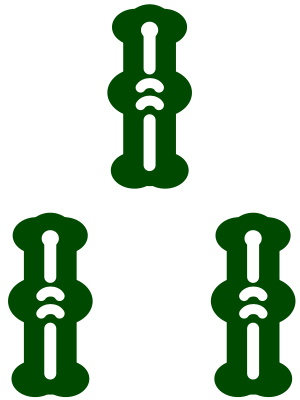
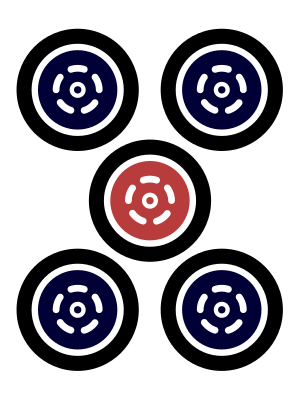
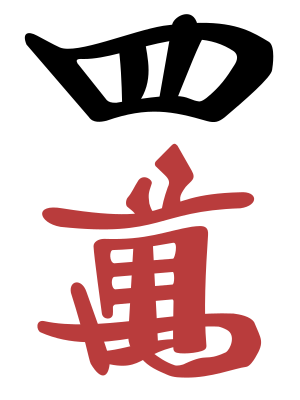
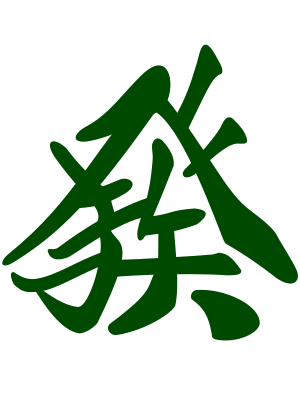
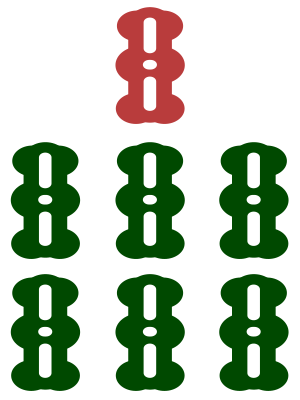
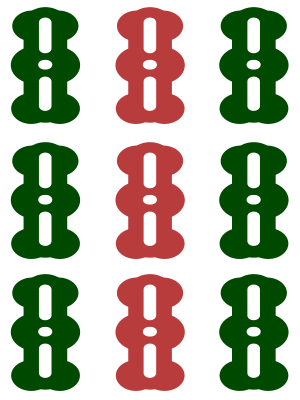
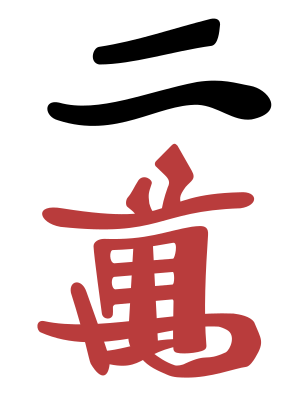
Taiwanese Mahjong uses the full standard tile set. Suits (Dots, Bamboo, Characters), Winds, and Dragons are all regular meld tiles. Flower and Season tiles (the 8 bonus tiles) are the only bonus tiles.
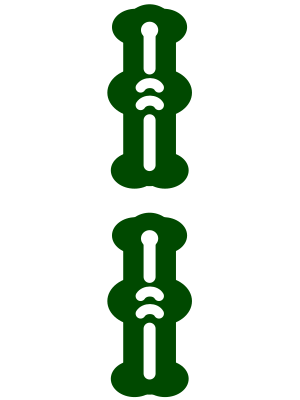
When you draw a Flower or Season tile, you reveal it, set it aside, and draw a replacement from the back of the wall. All other tiles stay in hand.
Suited tiles form Chows; Winds and Dragons form Pong/Kong, never sequences.
Dragons can form Pong and Kong — each earns +1 tai.
Only 8 specific tiles (Flowers + Seasons) trigger the reveal-and-replace rule.
The dealer holds 17 tiles and discards first; all others start with 16.
How a Turn Works in This Mode
The turn flow is the same draw-improve-discard rhythm as other Mahjong modes. The key addition is that any Flower/Season draw triggers an immediate reveal and replacement before the regular discard.
Before each discard, mentally count your current tai. If the hand is already at 1+ tai and near completion, finishing safely is often the right call.
Draw one tile.
If it is a Flower/Season tile, reveal and replace it immediately.
Improve your hand structure and count tai.
Discard one tile.
After a win call, tally all flower tai + win pattern tai before payments are made.
Claims and Call Priority
Claims follow the standard WIN > KONG > PONG > CHOW priority. Because Dragon and Wind Pong earn tai, taking Pong claims on these tiles is often strategically valuable — not just for speed.
Concealed Hand (+1 tai) is a meaningful bonus in Taiwanese, so consider whether skipping a Chow claim is worth the extra tai.
CHOW: left-player discard only; three consecutive same-suit tiles.
PONG: any opponent discard; three identical tiles.
KONG: four identical tiles; draw a replacement after declaring.
Concealed Kong is declared from drawn tiles and pays +1 tai from all opponents immediately.
How to Build a Hand
Identify your tai sources in the opening turns. A Dragon Pong is easy to plan around if you have two Dragons early. Wind Pong on your seat wind is another natural target.
Mixed One Suit (+3 tai) and Pure One Suit (+7 tai) are high-value routes if your opening hand leans heavily into one suit with honors.
Keep Dragon pairs as long as a Pong is reachable.
Build toward Pengpeng (+2 tai) if your hand is naturally triplet-heavy.
Seven Pairs + Pong (+3 tai) needs 7 unique pairs plus a separate triplet; a Dragon/Wind triplet still scores normally.
Flowers are free tai — count them as they arrive.
How to Tell If You Can Win
A win requires both a complete 17-tile hand shape AND at least 1 tai total. Flower tai and win pattern tai both count toward this.
Before calling a win, run through: flower count + pattern tai. If the sum is 0, you cannot win even with a complete hand.
Count flower tai first — each Flower/Season tile in your bonus area is +1 tai.
Add pattern tai from the hand itself (Dragon Pong, Pengpeng, Seven Pairs + Pong, etc.).
Self-draw (Zimo) also adds +1 tai to the win total.
If total tai ≥ 1, the win is legal.
How Scoring Works in This Mode
All tai stack additively. Flower tai is paid flat by all three opponents. Win tai uses a split: on a discard win, the discarder pays 2× win_tai and each other opponent pays 1× win_tai. On self-draw (Zimo), each of 3 opponents pays 1× win_tai.
Flower tai is always added on top and paid equally by everyone regardless of win type.
Each Flower/Season tile held = +1 tai (paid by all 3).
Self-Draw (Zimo) = +1 tai.
Dragon Pong/Kong = +1 tai each.
Seat Wind Pong = +1 tai.
All Triplets (Pengpeng) = +2 tai.
Seven Pairs + Pong = +3 tai.
Mixed One Suit = +3 tai; Pure One Suit = +7 tai.
Your First Hand in This Mode
Your first Taiwanese hand should focus on one simple goal: finish a 17-tile hand with at least 1 tai. The 1 tai minimum is easy to clear — even one flower does it.
Do not overthink tai counting in the first session. Just be aware of whether you have any tai before calling the win.
Turn 1: Sort into connected suit blocks, honor pairs, and flower bonuses.
Turn 2: Identify the easiest tai source (usually a Dragon pair or an early flower).
Turn 3: Discard the weakest tile while protecting the tai source.
Turn 4 onward: Build structure normally while counting tai as patterns solidify.
Beginner Strategy Playbook
In Taiwanese Mahjong, tai accumulates quickly once you have 2-3 sources working together. The best beginner approach is to identify one primary tai route early and protect it through normal hand building.
Keep Dragon and seat-wind pairs — both are +1 tai Pong routes.
Count your flowers as free tai — 2 flowers already clears the minimum.
Prefer Pong over Chow when honors are involved.
Consider Concealed Hand (+1 tai) if your hand is naturally closed.
Do not fear Seven Pairs + Pong if you draw into many pairs plus a natural triplet early.
Defense and Risk Management
Because wins carry multiplied payouts (discarder pays 2× win_tai), a high-tai hand can deliver significant point swings. Pay attention to opponent discard patterns and exposed melds.
If an opponent has 3+ flower bonuses showing, their hand is scoring higher — be more cautious with your late discards.
Watch exposed honor melds — each Dragon Pong an opponent shows is +1 tai against you if they win.
Discard tiles that are already out in the discard pool when possible.
If the wall is short and your hand is not ready, fold safely rather than feed a high-tai hand.
Concealed hands are harder to read — treat caution as the default in late-wall situations.
Worked Scenarios
Basic Scenario: Clearing the 1 Tai Minimum
Setup: Your opening hand has two White Dragons and several connected suit tiles.
Objective: Build toward Dragon Pong to guarantee the 1 tai minimum.
Hold the Dragon pair and wait for the third from a draw or discard.
Build suit melds around the Dragon pair normally.
When the Dragon Pong completes, you have at least 1 tai guaranteed.
Finish the remaining 14 tiles (4 more sets plus 1 pair) to win.
Expected outcome: The hand wins legally because Dragon Pong gives +1 tai.
Dragon Pong is the easiest beginner tai source to plan around.
Mid Scenario: Zimo vs Discard Win
Setup: You are one tile away from winning. You can take a discard or wait to self-draw.
Objective: Understand the payout difference between Zimo and discard win.
Calculate current tai (e.g., 1 flower + Dragon Pong = 2 tai).
On discard win: discarder pays 2×2 = 4; each other opponent pays 1×2 = 2. Total received: 8.
On self-draw (adds +1 tai for Zimo = 3 tai): each opponent pays 3. Total received: 9.
Decide based on wait quality and wall tiles remaining whether to push for Zimo.
Expected outcome: You understand when self-draw is worth waiting for.
Zimo adds +1 tai and changes the payout split — it can be worth waiting for a turn or two.
Advanced Scenario: Pengpeng Route
Setup: Your hand is naturally triplet-heavy after the first few draws.
Objective: Commit to All Triplets (Pengpeng) for the +2 tai bonus.
Identify which tiles you already have pairs or triplets for.
Skip Chow claims entirely to preserve the Pengpeng route.
Expected outcome: Pengpeng + Dragon Pong + flowers can easily produce 5-8 tai in one hand.
Commit to Pengpeng early — it is incompatible with Chow melds.
What Beginners Usually Misunderstand
Winds and Dragons are NOT flower tiles in Taiwanese
In Filipino Mahjong, all honors are flower tiles. In Taiwanese, only the 8 Flower/Season tiles are bonus tiles. Winds and Dragons are normal meld tiles.
Fix: Keep Winds and Dragons in hand. Meld them for Pong tai bonuses.
A complete hand with 0 tai still cannot win
Even if your 17-tile structure is perfect, you need at least 1 tai to declare a win. Most hands naturally have 1+ tai, but zero-tai hands do occur.
Fix: Always count tai before calling a win. One flower or one Dragon Pong is enough.
Flower tai and win tai are paid separately
Flower tai is paid by all 3 opponents equally, regardless of who discarded. Win tai follows the discarder-pays-double formula.
Fix: Calculate flower tai and win tai separately before determining each opponent's payment.
Common Mistakes and Fixes
Treating Winds/Dragons as flower tiles and discarding them. - Remember: only Flower/Season tiles are bonus tiles in Taiwanese. Keep and meld Winds and Dragons.
Calling a win with 0 tai. - Count tai before every win call. At least 1 tai is required.
Skipping Pong on a Dragon because the hand seems fast without it. - Dragon Pong is free +1 tai. Always evaluate whether a Dragon Pong claim improves tai without breaking the hand.
Ignoring the Pengpeng route when the hand is triplet-heavy. - If you have 3+ pairs early, check whether avoiding all Chow claims enables Pengpeng (+2 tai).
Practice Drills
Drill 1: Tai Count Before Win
Goal: Build the habit of always counting tai before declaring.
For 10 hands, count tai out loud before every win call.
Write the final tai total and who paid what after each hand.
Mark any hand where you would have called a win illegally (0 tai).
Success check: You can calculate flower tai + win pattern tai in under 10 seconds before declaring.
Drill 2: Dragon Pong Route
Goal: Practice building around Dragon Pong as a primary tai source.
For 5 hands, hold any Dragon pair and wait for the third.
Note how often the Dragon Pong completed and how it affected final tai.
Compare wins with Dragon Pong to wins without.
Success check: Dragon Pong completes in at least 3 of 5 attempts.
Drill 3: Zimo vs Discard Decision
Goal: Practice evaluating whether to wait for self-draw.
Each time you reach tenpai, calculate the tai for Zimo (+1 extra) versus immediate discard win.
Decide whether the extra tai justifies waiting.
Record 5 decisions and check the outcomes.
Success check: You can explain the payout difference for each decision after the hand.
Drill 4: Flower Replacement Audit
Goal: Separate Flower/Season replacement from regular honor-tile handling.
For 5 hands, pause whenever you draw a Wind, Dragon, Flower, or Season tile.
Reveal and replace only Flower/Season tiles.
Keep a note of every Wind or Dragon you kept, melded, or discarded as a normal tile.
Success check: You no longer expose Winds or Dragons as bonus tiles in Taiwanese hands.
Drill 5: Claim Direction and Tai Tradeoff
Goal: Practice skipping claims that are illegal or cost too much tai.
For 10 claim prompts, say whether CHOW is allowed from that discarder before choosing.
When a legal Chow appears, compare its speed against losing Concealed Hand (+1 tai).
When a Dragon or seat-wind Pong appears, calculate how it changes your minimum tai status.
Success check: You can reject right-player Chows and explain when a legal Chow is still worse than preserving tai.
Ready-to-Play Checklist
I hold 16 tiles and win when the 17th completes the hand.
I know only Flower/Season tiles are bonus tiles — Winds and Dragons are meldable.
I know I need at least 1 tai (flower tai counts) to declare a valid win.
I know discard win: discarder pays 2× win_tai; others pay 1× win_tai.
I know self-draw (Zimo): all 3 opponents pay 1× win_tai + flower_tai each.
Mode FAQ
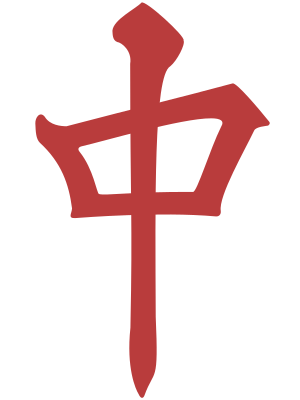
Can I Pong on East Wind or Red Dragon?
Yes. In Taiwanese Mahjong, Winds and Dragons are fully meldable. Dragon Pong earns +1 tai.
What is the minimum tai to win?
At least 1 tai total (flower tai + win pattern tai combined). Most hands naturally exceed this.
Do flower tiles count toward the 1 tai minimum?
Yes. Each Flower/Season tile in your bonus area is +1 tai, and this counts toward the minimum.
Who pays flower tai and who pays win tai?
Flower tai is paid equally by all three opponents. Win tai is paid with a 2× penalty on the discarder (on a discard win) or equally by all three on self-draw.
Learn Taiwanese Mahjong online with 16-tile Taiwan Mahjong rules, meldable honors, Flower/Season replacement, tai scoring, examples, and tutorials. This static route summary is written to be useful before the interactive client loads: it states the question, the practice path, and the next action a Mahjong learner can take on the same site.
Last reviewed: 2026-05-05. Review cadence: monthly.
Search Intents Covered
taiwanese mahjong rules - answered with route-specific examples, practice links, and rule checks.
taiwanese mahjong - answered with route-specific examples, practice links, and rule checks.
taiwan mahjong rules - answered with route-specific examples, practice links, and rule checks.
taiwan mahjong 16 tiles - answered with route-specific examples, practice links, and rule checks.
taiwanese mahjong tai scoring - answered with route-specific examples, practice links, and rule checks.
play taiwanese mahjong online - answered with route-specific examples, practice links, and rule checks.
Questions Answered
What makes Taiwanese Mahjong different?
How do flowers work in Taiwanese Mahjong?
Can I play Taiwanese Mahjong online on tsumo.io?
Questions This Page Answers
What makes Taiwanese Mahjong different?
How do flowers work in Taiwanese Mahjong?
Can I play Taiwanese Mahjong online on tsumo.io?
tsumo is a free browser-based Mahjong platform supporting Chinese, Hong Kong, Riichi, MCR, Filipino, and Taiwanese rulesets with tutorials, daily puzzles, and bot practice.