 tsumo
tsumoTanyao (All Simples) 1-Han Blueprint
Strictly middle numbers 2-8; no terminals or honor tiles.
Learn the first Riichi yaku beginners should know, how to recognize them in real hands, why dora is not yaku, and how yaku shape decisions during play.
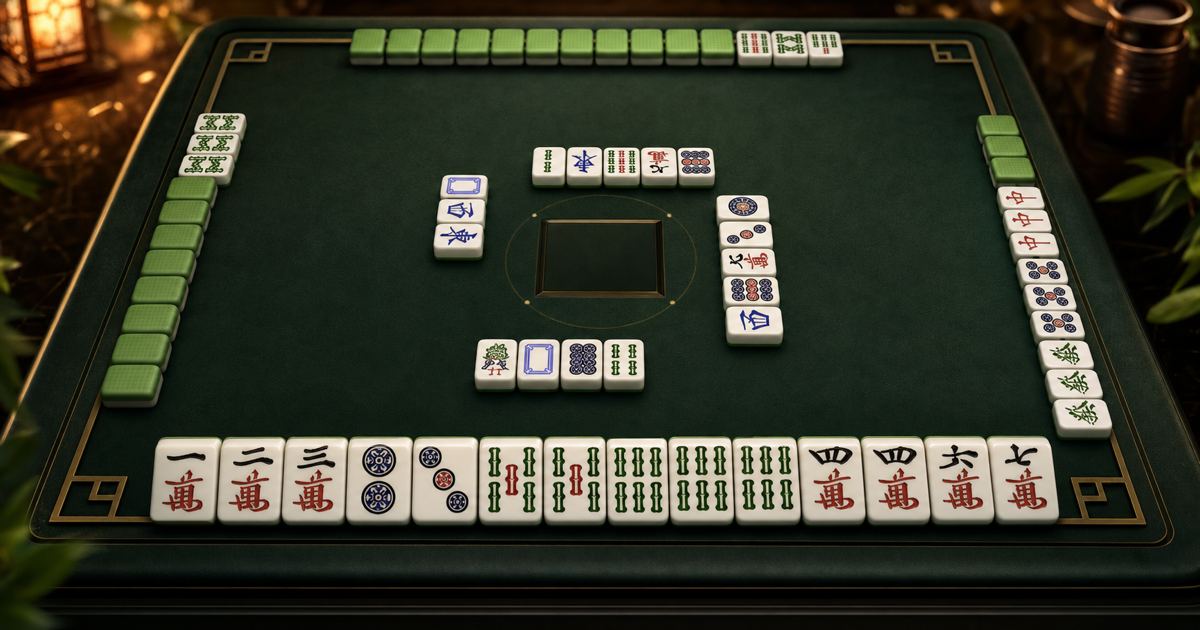
Comprehensive guide to beginner Riichi yaku: Tanyao, Pinfu, Yakuhai, Riichi, Honitsu, Chiitoitsu, exact conditions, tile blueprints, and the Dora trap.
In Riichi Mahjong, having four sets and a pair is not enough to win. Your hand must satisfy at least one Yaku (a recognized scoring pattern) worth at least 1 Han.
If you complete your hand without a Yaku and declare Ron or Tsumo, you commit Chombo (a severe foul) and must pay penalty points to all opponents.
Master these four fundamental Yaku first; they account for over 80% of hands won by beginners in Riichi Mahjong.
Strictly middle numbers 2-8; no terminals or honor tiles.
Closed hand, 4 sequences, valueless pair of 8 Dots, two-sided wait.
| Yaku Name | State | Han Value | Exact Winning Condition |
|---|---|---|---|
| Riichi | Closed Only | 1 Han | Declare Tenpai on closed hand, bet 1,000 pts; unlocks Ippatsu and Ura-Dora. |
| Tanyao (All Simples) | Open or Closed | 1 Han | Construct hand using only suited numbers 2 through 8; no 1s, 9s, Winds, or Dragons. |
| Yakuhai (Value Honors) | Open or Closed | 1 Han per set | Form a triplet of Dragons (Red, Green, White), Seat Wind, or Round Wind. |
| Pinfu (All Sequences) | Closed Only | 1 Han | Four sequences, neutral non-scoring pair, two-sided sequence wait (0 minipoints). |
Once the four starter yaku are comfortable, add these two powerful intermediate patterns to your arsenal.
Honitsu (Half Flush): Built using tiles from only one suited family plus honor tiles (Winds and Dragons). Worth 3 Han if closed, and 2 Han if open.
Chiitoitsu (Seven Pairs): Built using exactly seven distinct pairs. Always closed, worth 2 Han, and scored with a flat 25 Fu.
Single suit (Bamboo) combined with White Dragon triplet and East pair.
Dora tiles add bonus Han to your hand payout, but Dora itself does not satisfy the 1-Han win requirement.
A hand with three Dora tiles and no Yaku is an illegal 0-Han hand and cannot win. Always ensure your hand has a valid Yaku (like Tanyao or Riichi) before relying on Dora value.
Pinfu (All Sequences / All Chows) is the most common closed-hand Yaku in Riichi Mahjong, worth 1 Han. It literally translates to "flat hand" because it awards zero minipoints (Fu).
To qualify for Pinfu, a hand must satisfy all four conditions simultaneously:
Condition 1 (Concealed Hand): The hand must be completely closed (Menzenchin). No open Pon, Chi, or Kan calls allowed.
Condition 2 (All Sequences): All four sets must be 3-tile suited sequences (Chows / Shuntsu). No triplets or quads allowed.
Condition 3 (Neutral Pair): The pair must NOT be a scoring honor tile (cannot be Dragons, Seat Wind, or Round Wind).
Condition 4 (Two-Sided Wait): The final wait (Machi) must be an open-ended two-sided sequence wait (Ryanmen, e.g. 4-5 waiting on 3 or 6). Inside waits (Kanchan), edge waits (Penchan), and pair waits (Tanki) disqualify Pinfu.
When middle suited tiles are scarce, pivot your hand toward terminal and honor patterns:
Chanta (Terminal and Honor Hand): Every set and the pair must contain at least one terminal (1 or 9) or honor tile. Worth 2 Han closed, and 1 Han open.
Honitsu (Half Flush): Built using tiles from only one suited family mixed with Winds and Dragons. Worth 3 Han closed, and 2 Han open.
Chiitoitsu (Seven Pairs): Built using seven distinct pairs. Always closed, worth 2 Han, and scored with flat 25 Fu.
| Yaku Name | English Name | Closed Han | Open Han | Core Requirement |
|---|---|---|---|---|
| Riichi | Ready Hand Declaration | 1 Han | N/A | Declare tenpai on closed hand, bet 1,000 pts |
| Menzen Tsumo | Fully Concealed Self-Draw | 1 Han | N/A | Self-draw winning tile with fully closed hand |
| Tanyao | All Simples | 1 Han | 1 Han | Tiles 2-8 only; no 1s, 9s, or honors |
| Yakuhai | Value Honor Triplet | 1 Han | 1 Han | Triplet of Dragons, Seat Wind, or Round Wind |
| Pinfu | All Sequences | 1 Han | N/A | 4 sequences, neutral pair, 2-sided wait, closed |
| Iipeikou | Pure Double Chow | 1 Han | N/A | Two identical sequences in same suit (e.g. two 2-3-4 Dots) |
| Sanshoku Doujun | Mixed Triple Chow | 2 Han | 1 Han | Same sequence in Dots, Bamboo, and Characters |
| Ittsu | Pure Straight | 2 Han | 1 Han | 1-2-3, 4-5-6, 7-8-9 in the exact same suit |
| Chiitoitsu | Seven Pairs | 2 Han | N/A | 7 distinct pairs (flat 25 fu) |
| Honitsu | Half Flush | 3 Han | 2 Han | Single suited family mixed with honor tiles |
No. Dora adds Han value only after your hand has at least one valid Yaku. A hand with four Dora and no Yaku is illegal and cannot declare Ron or Tsumo.
1. Fully closed hand (Menzenchin). 2. All four sets must be sequences (Chows). 3. The pair must not be a scoring honor (no Dragons, Seat Wind, or Round Wind). 4. The final wait must be a two-sided sequence wait (Ryanmen).
Common Pinfu disqualifications include: opening the hand with an open call (Chi/Pon), using an active Dragon or Seat Wind as the pair, or winning on an inside wait (like 2-4 waiting on 3) instead of a two-sided wait.
Honitsu (Half Flush) uses tiles from one suit mixed with honor tiles (3 Han closed / 2 Han open). Chinitsu (Full Flush) uses tiles from one single suit with zero honor tiles (6 Han closed / 5 Han open).