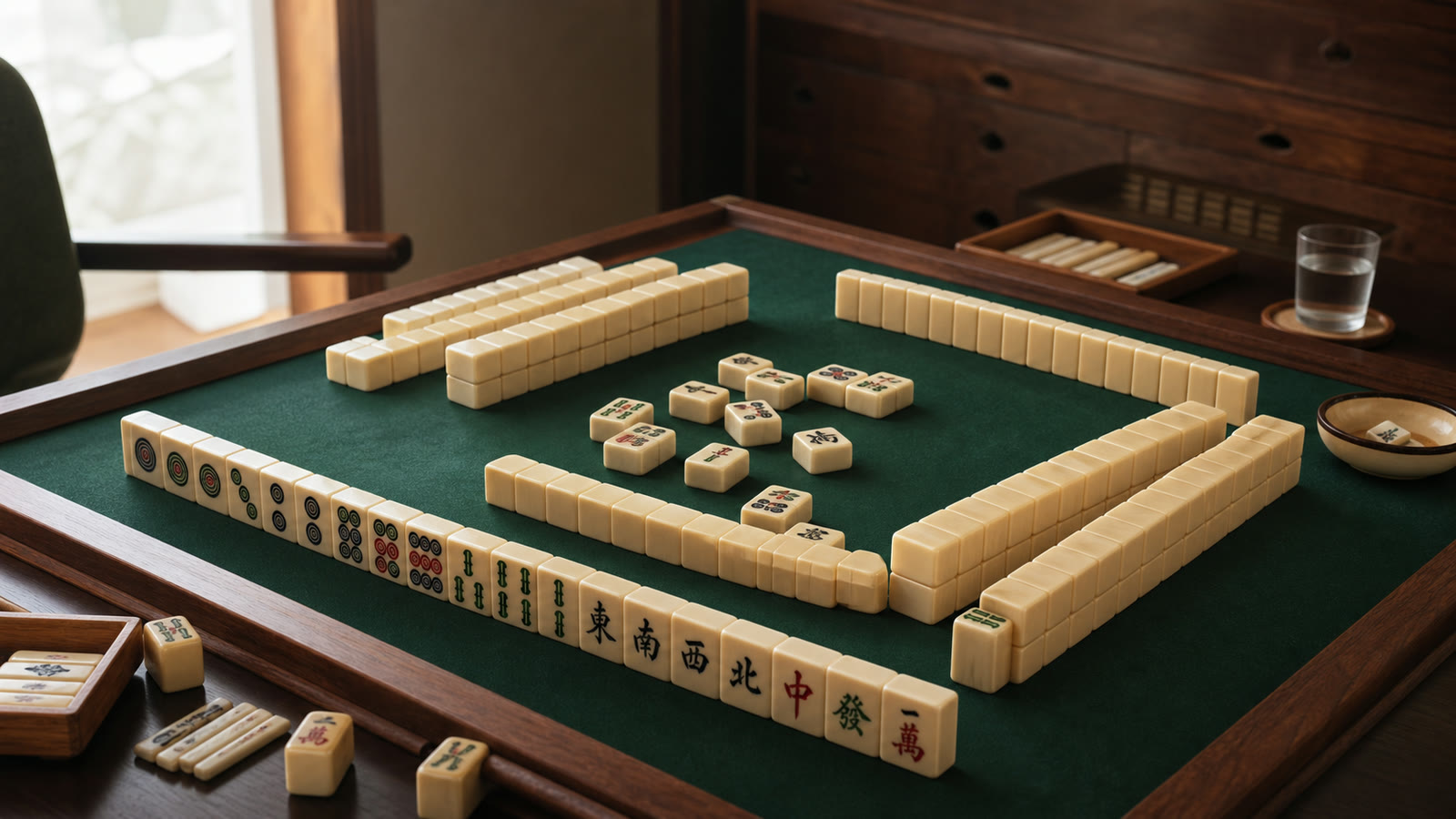
Compare Mahjong terms across Chinese, Japanese, and English, including chow, pung, kong, ron, tsumo, yaku, faan, tai, card terms, and calls.
Read this post, then follow the linked practice or community path.
The live app experience on tsumo follows the same route structure, ruleset labels, and practice surfaces linked below.
Blog focus
Read the latest Mahjong blog posts from tsumo.
Follow internal links to connect each post back to local clubs, puzzles, tutorials, and playable routes.
By tsumo Editorial. Published 2026-06-29, updated 2026-06-29. 8 minute read.
Mahjong terms travel across languages, but translation can hide rule differences, table customs, and the way players think about a hand.
Mahjong terminology is practical. A word tells the table what action happened, what scoring concept applies, and which tradition the players are using. Translation helps, but it can also make different rules look more similar than they are.
Mahjong terms travel across languages, but translation can hide rule differences, table customs, and the way players think about a hand. It treats terminology as table infrastructure for timing, scoring, disputes, and cross-variant clarity.
WRC, Riichi Book 1, NMJL, and MIL sources support terminology across Japanese, American, and international rules language.
Action words travel first
Chow, pung, kong, chi, pon, kan, ron, and tsumo are not just vocabulary; they trigger table procedure. Different spellings often point to different language histories or ruleset conventions.
Practice move: Use the term your table understands, then explain the action behind it.
Scoring terms do not map neatly
Yaku, han, fu, faan, tai, and point patterns describe different scoring systems.
Translating all of them as points can erase the legality checks that make variants distinct. Keep scoring terms tied to their ruleset.
American card language
American Mah Jongg uses terms shaped by the annual card, racks, jokers, and Charleston flow.
That vocabulary can confuse players coming from Riichi or Chinese group-building variants. When teaching American play, introduce the card as a language system.
Digital platforms normalize spellings
Online clients spread Japanese Riichi terms quickly because interface labels become the default teacher. That is useful for global study but can make other Mahjong traditions less visible.
Practice move: Name alternate terms when a piece crosses variants.
How to learn terminology safely
Learn terms by decision context instead of memorizing a glossary in isolation.
A word sticks when it tells you what to do next at the table. Pair every new term with an example hand or action.
Practical Checklist
Ask which language convention the table uses.
Do not translate scoring units as if they are identical.
Learn action terms with table timing.
Use platform vocabulary carefully outside that platform.
Keep a small glossary for new players.
Where to Go Next
Learn Mahjong online - Use the beginner learning path when a piece raises a rule, scoring, or table-flow question you want to practice.
Read Riichi rules - Use the Riichi rules guide for yaku, furiten, reach declarations, and push-fold decisions mentioned here.
Read MCR rules - Use the MCR guide when international competition, pattern scoring, or point-gate language needs a concrete rules reference.
Practical Applications
Table-Ready Glossary
Terminology becomes useful when it prevents a mistake at the table. A compact glossary should group words by function rather than by language prestige: calls, hand structure, scoring, penalties, and event procedure. That helps a player translate between Riichi, Chinese-language variants, American Mah Jongg, and MCR without pretending the terms are exact synonyms.
Win declaration: ron and tsumo in Riichi map roughly to discard win and self-draw, but other variants may use different language and payment logic.
Set calls: chi, pon, and kan describe Riichi-style sequence, triplet, and quad calls; American Mah Jongg uses exposure language tied to the card.
Hand requirement: yaku is central in Riichi, while American play asks for a matching card hand and MCR uses pattern points.
Ready hand: tenpai is common Riichi vocabulary, but a host should still explain what one-away means for the chosen variant.
Penalty language: chombo, dead hand, and table error should be defined from the event document before a tournament starts.
The safest teaching move is to define the term, name the variant, and give one example. For example: in Riichi, furiten can prevent a ron win on a tile you otherwise appear to need. That sentence is more useful than simply translating furiten as sacred discard or forbidden wait.
A multilingual table also benefits from humility. If a family table uses Cantonese, Mandarin, Japanese, Filipino, or English house vocabulary differently from a guide, the room vocabulary should be recorded rather than corrected automatically.
Terminology as Table Infrastructure
Terms are table infrastructure because they let four players coordinate timing. A call name tells the table to pause. A ready-hand term tells players what kind of danger may exist. A penalty term tells a tournament how to repair an error. A scoring term tells learners what kind of value the hand has. Translation matters because a wrong term can change behavior, not just vocabulary.
Readers should avoid glossary dumping. A better structure groups terms by moment: before the hand, during a call, during a win, during scoring, and during a dispute. Each term should answer why a player needs it at that moment. For example, furiten is not just a Japanese word; it is a live constraint on whether a player can win by ron.
Before the hand: seat wind, round wind, dealer, card, wall, dead wall, Charleston.
During the hand: chi, pon, kan, exposure, joker exchange, discard, claim priority.
At win: ron, tsumo, mahjong, fan, yaku, hand category, payment.
At dispute: dead hand, chombo, missed call, invalid exposure, house rule, judge call.
How to Handle Language at Mixed Tables
Mixed-language tables work best when terms are defined before they are corrected. If one player says pung and another says pon, the host can connect both to a triplet call in the active ruleset, then explain any timing differences that matter. The goal is shared procedure, not vocabulary dominance.
Players should ask what does that mean at this table. That phrase respects local usage while still protecting accuracy. It is especially useful when American Mah Jongg, Riichi, MCR, and family Chinese terms appear in the same room.
Good terminology also helps online learning. Search terms, tutorial labels, and platform buttons may use Japanese, Chinese, or English words inconsistently. A reader who understands function can navigate those differences without assuming the app is wrong or the local table is wrong.
Glossary Maintenance
A terminology glossary should be maintained like a living glossary. If the site adds more rules pages, each term should link to the variant where it matters. If a term is used differently in American, Riichi, MCR, or family play, the glossary should say so directly. That prevents search traffic from landing on a confident but incomplete definition.
Local glossary notes help mixed-language tables. A club can keep a short list of words used in the room, especially when multiple languages are present. That list turns terminology into inclusion rather than gatekeeping and gives newcomers a reference they can revisit after play.
Terms That Change Actions
A useful terminology glossary prioritizes terms that change actions. Some words are nice cultural context; others determine whether a player can call, win, score, appeal, or continue a hand. Furiten, Charleston, joker exchange, yaku, fan, dead hand, and claim priority are not vocabulary ornaments. They tell players what is allowed right now. Useful terminology links terms to table moments. When does the word appear? Who needs to hear it? What mistake does it prevent? This approach makes multilingual play less intimidating because readers do not need perfect fluency before participating. They need enough shared language to keep the hand fair, visible, and repairable.
Source Notes and Limits
The cited sources use WRC and Riichi study materials for Japanese terms, NMJL context for American terminology, and Mahjong International League context for international rules language.
Terms are not treated as perfect translations. The advice encourages players to define the word, identify the variant, and confirm local table usage before correcting another player.
Quick FAQ
Should players correct pronunciation at the table? Only when it helps play and is welcome; clarity matters more than performing expertise.
Are terms exact translations? Often no. Terms carry rules, timing, and scoring assumptions that may not transfer cleanly between variants.
What is the best way to teach a new term? Define the word, name the variant, show one table example, and say when the term matters during play.
tsumo Editorial — tsumo Editorial is the organizational byline for source-backed Mahjong guides and articles published by tsumo. The team checks rules explanations against implemented app behavior and maintains corrections through the public contact process.
 tsumo
tsumo