 tsumo
tsumoCross-Variant Evaluation Hand
Red Dragon Triplet provides universal value across all variants.
A beginner-friendly explanation of Mahjong scoring, value gates, and differences across Chinese, Hong Kong, Riichi, MCR, Filipino, and Taiwanese rules.
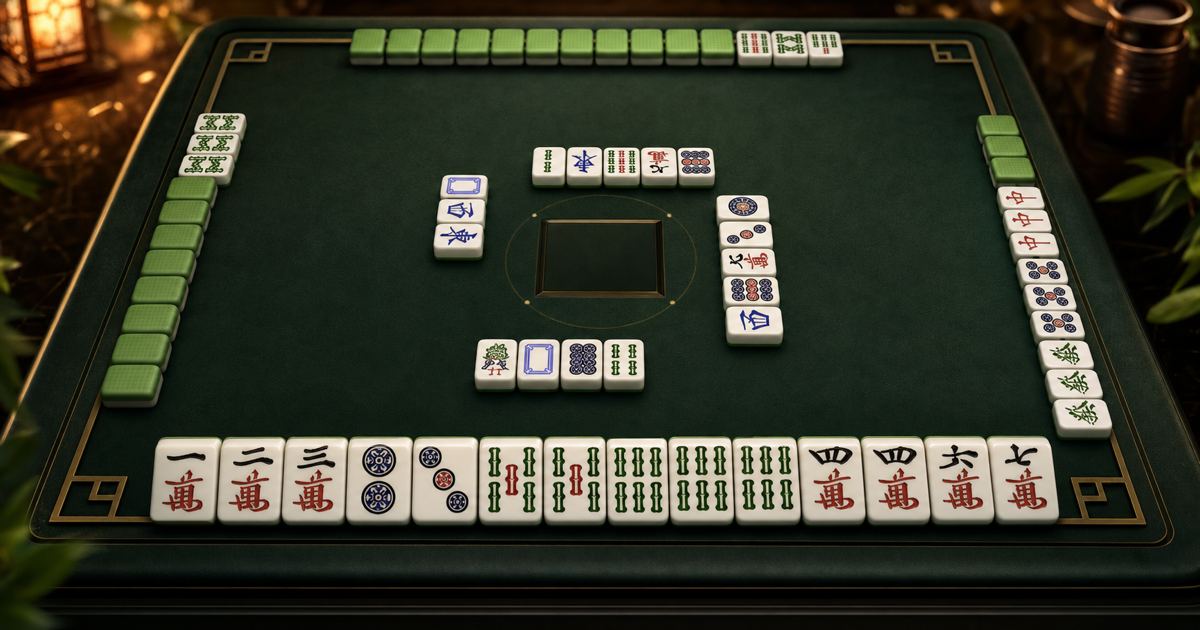
A comprehensive beginner guide to Mahjong scoring principles: scoring decision trees, base value vs multipliers, payment settlements, and cross-variant rules.
Mahjong scoring can feel overwhelming across different regional traditions, but every variant follows the exact same three-tier evaluation process.
Tier 1 is Structure Validation: Does the hand form a legal 4-meld + 1-pair shape or recognized special pattern?
Tier 2 is Legality Gate Verification: Does the hand satisfy the mandatory qualification threshold required to win at the table?
Tier 3 is Base Point & Multiplier Calculation: How many points, faan, tai, or han/fu does the hand award, and who pays?
Each major Mahjong variant uses a distinct currency and calculation model for hand value.
| Variant | Primary Currency | Minimum Win Gate | Calculation Style |
|---|---|---|---|
| Simplified Chinese | Flat Points / Hand Count | Structure Only (0 gate) | Additive basic points for speed |
| Hong Kong Classic (HKOS) | Faan (Doubling Units) | 3 Non-Flower Faan | Exponential doubling (1, 2, 4, 8, 16, 32 pts) |
| Japanese Riichi | Han (Multipliers) + Fu (Minipoints) | 1 Valid Yaku | Fu-based base points multiplied exponentially by 2^(Han+2) |
| MCR (Competition Rules) | Fan (Pattern Points) | 8 Non-Flower Points | Sum of 81 combinable official patterns |
| Taiwanese Mahjong | Tai (Additive Units) | 1 Tai Minimum | Additive base stakes + Tai bonuses |
| Filipino Mahjong | Pay Units / Cash Multipliers | Structure + Special Melds | Additive points with flower/honor bonuses and pot claims |
A critical distinction in Mahjong scoring is the difference between a qualifying condition and a bonus multiplier.
In Riichi, Dora tiles add 1 Han each to your hand value, but Dora is never a Yaku—a hand with four Dora and no Yaku cannot win.
In Hong Kong Classic, Flower tiles add 1 Faan if they match your seat wind, but traditional 3 non-flower Faan tables do not allow flower faan to count toward the mandatory 3 non-flower Faan qualification gate.
How table points change hands depends entirely on how the winning tile was acquired.
Self-Draw (Tsumo / Zimo / Bunot): When you draw the winning tile yourself from the wall, all three opponents split the payment and pay you equally. In Riichi and HKOS, dealer payments may be doubled.
Discard Win (Ron / Sik Wu): When you win off an opponent’s discard, that specific player alone is held responsible and pays the entire point total (or double payment), shielding the other two players from loss.
Consider the hand below: 1-2-3 Dots, 4-5-6 Dots, 2-3-4 Bamboo, Triplet of Red Dragons, and Pair of 8 Characters.
Red Dragon Triplet provides universal value across all variants.
Scoring feels overwhelming when you try to memorize every multiplier before you understand the turn loop. A better mental model is to treat scoring as three separate layers: eligibility (can I win right now?), structure (what shapes did I build?), and bonus value (what multipliers did I add?).
When a hand finishes, do not ask what the entire table owes right away. Ask which layer gave you the win. Did you qualify because of a dragon triplet, all simples, or a concealed hand? Once you identify the qualifying condition, the arithmetic becomes manageable.
How table points change hands depends on who provided the winning tile:
When you win by Self-Draw (Tsumo / Zimo), all three opponents split the payment and pay you equally (with the dealer paying double in Riichi and HKOS).
When you win off a Discard (Ron / Sik Wu), the player who discarded the winning tile bears sole table liability and pays the entire point total, sparing the other two innocent players from financial loss.
| Variant | Scoring Unit | Minimum Win Gate | Payment Dynamics |
|---|---|---|---|
| Simplified Chinese | Flat Points | None (0 gate) | Discarder pays all or 3 split on self-draw |
| Hong Kong Classic | Faan (Doubles) | 3 Non-Flower Faan | Exponential doubling; discarder pays full or 3 split on zimo |
| Japanese Riichi | Han & Fu | 1 Valid Yaku | Fu base multiplied by 2^(Han+2); discarder pays full |
| MCR (Guobiao) | Fan Points | 8 Points | 8 base points + individual opponent point differentials |
| Taiwanese | Tai Points | 1 Tai Minimum | Base stakes + Tai points; discarder pays full or 3 split |
| Filipino | Pay Units | Structure + Special Melds | Additive points, flower/honor bonuses, pot claims |
In Riichi, Han is the primary multiplier tier earned from Yaku and Dora, while Fu represents minipoints earned from meld difficulty (triplets, terminals, closed waits). Fu determines base value, which is then multiplied exponentially by Han.
In Mahjong discard defense, every discard carries table risk. If a player discards a winning tile that an opponent claims (Ron), that player bears sole financial liability for dealing into the winning hand.
Mahjong evolved regionally over centuries. Hong Kong uses exponential Faan, Japan developed Han and Fu minipoints with heavy defensive penalties, China standardized 81 MCR patterns, and Taiwan and the Philippines created additive 16-tile point systems.
Focus on recognizing the 3 or 4 most common scoring routes in that specific ruleset (such as Tanyao/Pinfu/Yakuhai in Riichi, or All Chows/Half Flush in HKOS) before attempting to memorize the full scoring table.