 tsumo
tsumoSequence (Chow / Chi)
Three consecutive suited tiles in numerical order.
Learn how to play Mahjong step by step: tiles, turn order, claims, winning hands, scoring basics, and the fastest beginner path into real games.
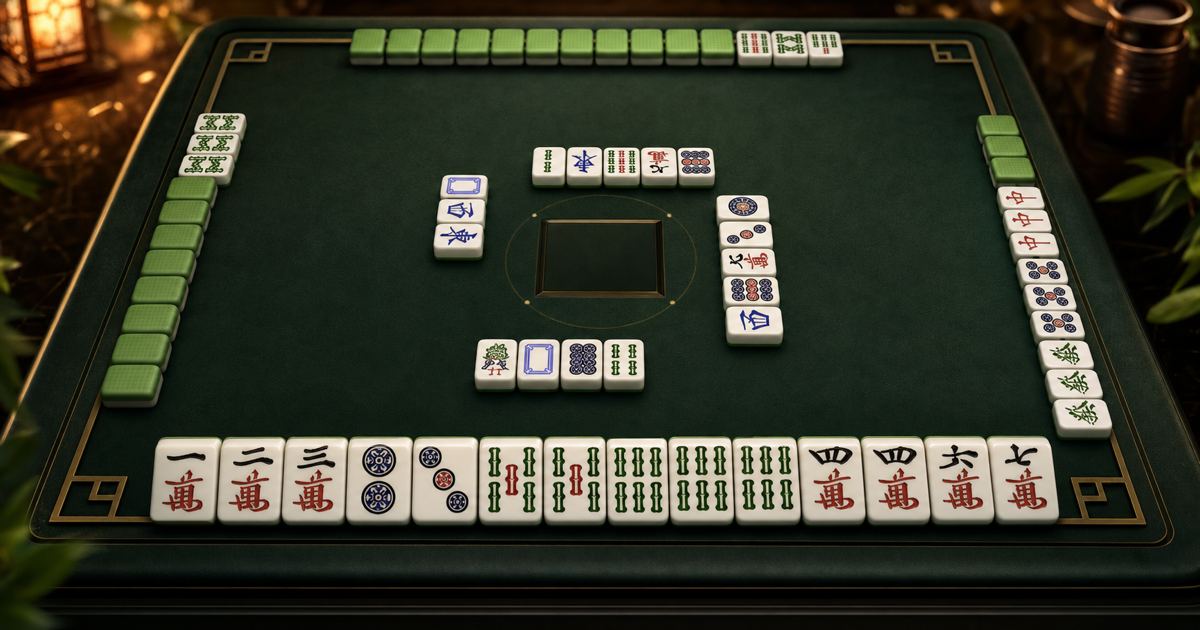
A complete beginner walkthrough of Mahjong: tiles, turn order, hand shape, claims, legal wins, and the fastest path from zero knowledge to your first confident game.
Mahjong is a four-player tile game built around hand construction, timing, and reading table state. Every player is trying to complete a legal winning hand before the wall runs out or another player wins first.
Across most major rulesets, the shared foundation is simple: build four sets and one pair, then make sure the hand also satisfies the scoring or eligibility rules of the variant you are playing.
If you are brand new, treat Mahjong as a decision loop instead of a memorization contest. Learn the flow first, then add scoring depth once the turn rhythm feels natural.
A standard turn starts when you draw one tile. You compare that draw against your current hand plan, then discard one tile that least supports your best route.
After your discard, other players may get claim rights. A claim can interrupt turn order, which is why claim timing matters almost as much as raw tile efficiency.
The fastest beginners improve when they say the loop out loud for a few games: draw, evaluate, discard, check claims, repeat.
Sets come in two main types: sequences (three consecutive numbers in the same suit, like 3-4-5 Dots) and triplets (three identical tiles, like three 8 Bamboos).
The pair is two identical tiles. Almost every standard hand requires one pair to serve as the eyes that anchor the four completed sets.
Three consecutive suited tiles in numerical order.
Three identical tiles.
Four identical tiles (triggers a replacement draw).
Two identical tiles serving as the eyes.
Four completed 3-tile sequences anchored by a pair of Red Dragons.
| Group Type | What It Looks Like | Suits That Can Form It |
|---|---|---|
| Sequence (Chow / Chi) | Three consecutive numbers (e.g. 4-5-6) | Dots, Bamboo, Characters only |
| Triplet (Pung / Pon) | Three identical tiles (e.g. 7-7-7) | Dots, Bamboo, Characters, Winds, Dragons |
| Quad (Kong / Kan) | Four identical tiles (e.g. East-East-East-East) | Any suit or honor family |
| Pair (Eyes) | Two identical tiles (e.g. Red Dragon-Red Dragon) | Any suit or honor family |
When another player discards a tile you need, you can claim it instead of waiting for your own draw.
Chi lets you take the previous player’s discard to complete a sequence. Pon lets you take any player’s discard to complete a triplet. Kan lets you declare a four-of-a-kind.
Calling tiles opens your hand to the table, which speeds up your development but exposes your plan and limits closed-hand scoring options.
One of the biggest beginner traps is assuming four sets and a pair always wins immediately.
In Simplified Chinese, that shape is enough. In Riichi, your hand must also contain at least one yaku. In Hong Kong Mahjong, it must reach the minimum faan threshold. In MCR, it must reach 8 points.
Treat structure as step one, and ruleset eligibility as step two.
A productive first session is not about winning quickly. It is about finishing a short loop of study, recognition, and live play without getting overloaded. The cleanest order in this app is one Simplified Chinese tutorial run, one five-minute puzzle block, then one bot game where you only care about hand shape. That structure teaches the same idea three different ways and makes the rules easier to retain than reading alone.
When beginners plateau early, it is usually because they consume Mahjong as isolated facts instead of linked actions. The tutorial shows the rule, puzzles force you to spot the right discard, and the game makes you execute under uncertainty. If you use all three in sequence, your first hour becomes real practice instead of passive reading.
The simplest discard framework is to rank tiles by how many future jobs they can still do. Connected middle tiles can become several different sequences, pairs can become eyes or triplets, and isolated honors often do nothing unless your variant specifically rewards them. If a tile is not improving your best route or preserving a realistic backup route, it usually moves toward the discard pile.
Beginners often ask for one universal discard rule, but Mahjong does not work that way. A safer target is a repeatable question set: does this tile connect, does it score, does it block a cleaner shape, and what happens if I keep it for one more turn. That question set works across Simplified Chinese, HKOS, Riichi, and MCR even when the scoring details differ.
| Milestone | What It Means | Good Next Step |
|---|---|---|
| You can explain four sets and one pair | Shape is no longer guesswork | Read the tiles guide and winning-hands guide |
| You spot obvious isolated tiles | Discard logic is becoming consistent | Practice daily puzzles for recognition speed |
| You know when a hand is complete but not legal | You are ready for scoring concepts | Move into scoring and variant comparison pages |
| You can finish one full bot game without confusion | Turn rhythm feels natural | Choose a variant and start its dedicated tutorial |
Start with Simplified Chinese mode to master the draw-discard turn loop, basic sequences, triplets, and the 4-set plus 1-pair winning hand shape. Once that foundation feels natural, transition into your chosen scoring ruleset (such as Hong Kong Classic, Riichi, or MCR).
In entry-level modes like Simplified Chinese, yes. In competitive rulesets like Riichi Mahjong, Hong Kong Classic, and MCR, your completed hand must also satisfy an eligibility gate (such as a Riichi Yaku, a 3 non-flower faan minimum, or an 8-point threshold).
Many players can understand the basic draw-discard loop and standard winning shape in one focused session. Calls, scoring, and defense take longer. Practice one ruleset consistently at first—the one used by your intended table, or the app onboarding profile when you have no preference—before comparing several systems in detail.
Learn one ruleset first. Build confidence around shape, legal wins, and common mistakes in one environment, then compare variants once those ideas are stable. Jumping between systems too early usually creates avoidable confusion about scoring gates and hand legality.