 tsumo
tsumoStandard All-Chow Hand Blueprint (4 Sequences + 1 Pair)
Four complete 3-tile sequences anchored by a pair of 9 Dots.
Understand Mahjong winning hands, standard hand shape, pairs and sets, special exceptions, and why legal wins still depend on the ruleset being played.
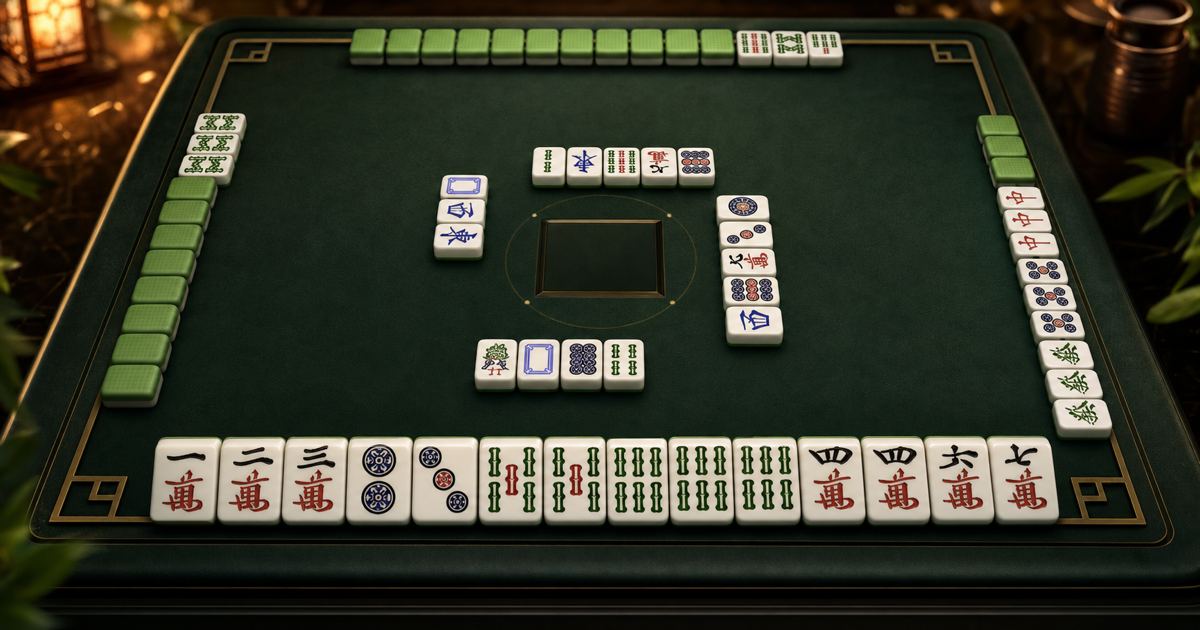
Understand standard Mahjong winning hand anatomy, 4-meld plus 1-pair structures, special non-standard exceptions, and wait quality diagnostics.
The default Mahjong target across almost all international rulesets is four complete sets (melds) and one pair (the eyes), totaling 14 tiles (or 17 tiles in 16-tile variants).
Melds can consist of sequences (Chows), triplets (Pungs), or quads (Kangs). The pair must consist of two identical tiles.
This 4-block plus 1-pair architecture is the primary blueprint you will assemble on almost every turn.
Four complete 3-tile sequences anchored by a pair of 9 Dots.
A few famous hands intentionally break the standard 4-set plus 1-pair structure and are recognized across competitive rulesets.
Seven Pairs (Chiitoitsu in Riichi, Siete Pares in Filipino) requires exactly seven distinct pairs of tiles with no duplicates between pairs.
Thirteen Orphans (Kokushi Musou / Sap Saam Yiu) requires one of each terminal (1 and 9 in all three suits), one of each Wind (East, South, West, North), one of each Dragon (Red, Green, White), plus a 14th tile forming a pair with any one of them.
Seven distinct pairs. Cannot contain four identical tiles treated as two separate pairs.
All 6 terminals and 7 honors, with a matching 1 Dot completing the pair.
Shanten measures how many tile improvements your hand needs before reaching ready status. A 2-shanten hand needs two improvements to become ready, while 1-shanten needs one.
Tenpai means your hand is ready: 13 tiles are perfectly shaped into four sets and a pair missing only one final winning tile (the Machi / wait).
Recognizing Tenpai quickly allows you to weigh the risk of discarding dangerous tiles versus the reward of your prospective hand value.
Not all Tenpai waits are created equal. The type of wait you hold dramatically affects your mathematical probability of winning.
| Wait Type | Shape Example | Winning Outs | Strategic Rating |
|---|---|---|---|
| Two-Sided (Ryanmen) | 4-5 waiting on 3 or 6 | Up to 8 live tiles | Optimal (highest win rate) |
| Closed / Inside (Kanchan) | 3-5 waiting on 4 | Up to 4 live tiles | Mediocre (easy to block) |
| Edge (Penchan) | 1-2 waiting on 3, or 8-9 waiting on 7 | Up to 4 live tiles | Rigid (low flexibility) |
| Dual Pair (Shanpon) | Pair of 2s and Pair of 7s | Up to 4 live tiles | Decent (can win on either pair) |
| Single Pair (Tanki) | 4 completed melds, waiting for pair | Up to 3 live tiles | Flexible (can switch targets easily) |
Never declare a win based on shape alone. A successful Mahjong player always performs a two-pass mental check before declaring Ron or Tsumo:
Pass 1 (Structure): Do my 14 tiles fit into four complete melds and one pair (or Seven Pairs / Thirteen Orphans)?
Pass 2 (Eligibility): Does my hand satisfy the variant-specific win condition? In Riichi, do I have at least 1 Yaku? In HKOS, do I have 3 non-flower Faan? In MCR, do I have 8 points?
Honor tiles (Winds and Dragons) and bonus tiles (Flowers and Seasons) have varying values depending on which ruleset you play.
In Hong Kong Classic, Flower tiles add 1 Faan if they match your seat wind, but traditional 3 non-flower Faan tables do not allow flower faan to count toward the mandatory 3 non-flower Faan qualification gate.
In Japanese Riichi, Flowers are excluded entirely, but Dragon triplets (Yakuhai) award an immediate 1-Han Yaku that makes the hand legally eligible to win.
Let us test your understanding with four common table scenarios:
Example 1: Open hand with three suited sequences, one suited triplet, and a pair of 5 Dots (0 Yaku in Riichi, 0 Faan in HKOS). Verdict: Legal in Simplified Chinese only; illegal in Riichi and HKOS.
Example 2: Closed hand with four suited sequences and a neutral pair of 8 Bamboos (Pinfu in Riichi). Verdict: Legal in Riichi and Simplified Chinese; needs additional faan in HKOS.
Example 3: Open hand with 1-2-3 Dots, 4-5-6 Dots, 7-8-9 Dots, Triplet of Red Dragons, and Pair of East Winds. Verdict: Legal in Riichi (Yakuhai = 1 Han); in Hong Kong Classic: Legal if combined with other faan (Dragon = 1 Faan; needs 2 more faan for 3 non-flower Faan gate).
Example 4: Seven distinct pairs in a closed hand. Verdict: Legal in Riichi (Chiitoitsu = 2 Han) and MCR (24 Points); illegal in traditional HKOS unless playing special house rules.
A reliable winning-hand check happens in two passes. First, verify structure: can the tiles be arranged into four legal groups and one pair. Second, verify eligibility: does the current ruleset allow that structure to win right now. That second step is where many newer players slip, especially in Riichi and MCR, because the tiles look complete but the hand is still missing the scoring condition that makes the win legal.
If you say both checks out loud during practice, hand reading gets dramatically cleaner. Structure answers whether the tiles fit together. Eligibility answers whether the variant accepts that finished shape. Once those become separate thoughts, you stop misreading complete-looking hands as automatic wins.
Shanten is the mathematical measure of how many tile swaps away your hand is from reaching Tenpai (ready to win).
A starting 13-tile hand typically begins at 3-shanten or 4-shanten. To calculate shanten: count your completed sets (each reduces shanten by 1), count your prototype 2-tile partial sets (each reduces shanten by 1, up to a maximum of 4 sets total), and check if you hold a pair (reduces shanten by 1).
By tracking shanten on each draw, you stop guessing whether a discard made your hand faster—you can objectively verify whether your shanten decreased.
| Variant | What Makes Winning Harder | Beginner Focus |
|---|---|---|
| Simplified Chinese | Very little scoring friction | Learn clean shape and turn rhythm |
| HKOS | Minimum faan requirement | Keep legal value routes in view |
| Riichi | At least one yaku and furiten constraints | Separate shape from legality |
| MCR | Eight-point pattern threshold | Plan scoring routes before the hand is finished |
| Taiwanese | 16-tile hand (5 sets + 1 pair) and 1 tai minimum | Manage larger tile counts and meldable honors |
| Filipino | 16-tile hand, flower replacement, and pot rules | Track special melds, honor transforms, and cash payouts |
A standard winning hand contains 14 tiles arranged as 4 sets and 1 pair in 13-tile variants (like Riichi, HKOS, MCR, and Simplified Chinese). In 16-tile variants (Taiwanese and Filipino), a winning hand contains 17 tiles arranged as 5 sets and 1 pair.
A completed 14-tile hand can fail if it does not satisfy the scoring gate of the variant being played. For example, Riichi requires at least one active Yaku, HKOS requires 3 non-flower Faan, and MCR requires 8 points.
Yes. A structurally complete hand can still fail the ruleset-specific legality check. Riichi may be missing yaku, HKOS may be short of faan, and MCR may not reach the point threshold.
No. Learn the standard hand structure first, because it explains most decisions you will face in early games. Special hands are easier to absorb once the standard framework is automatic.