 tsumo
tsumoDots Suit (Pin) — 1 to 9
Four copies of each numbered Dot tile (36 total Dots).
A beginner Mahjong tiles guide covering suits, honors, terminals, simples, flowers, tile groups, and how to read each tile's role during real hands.
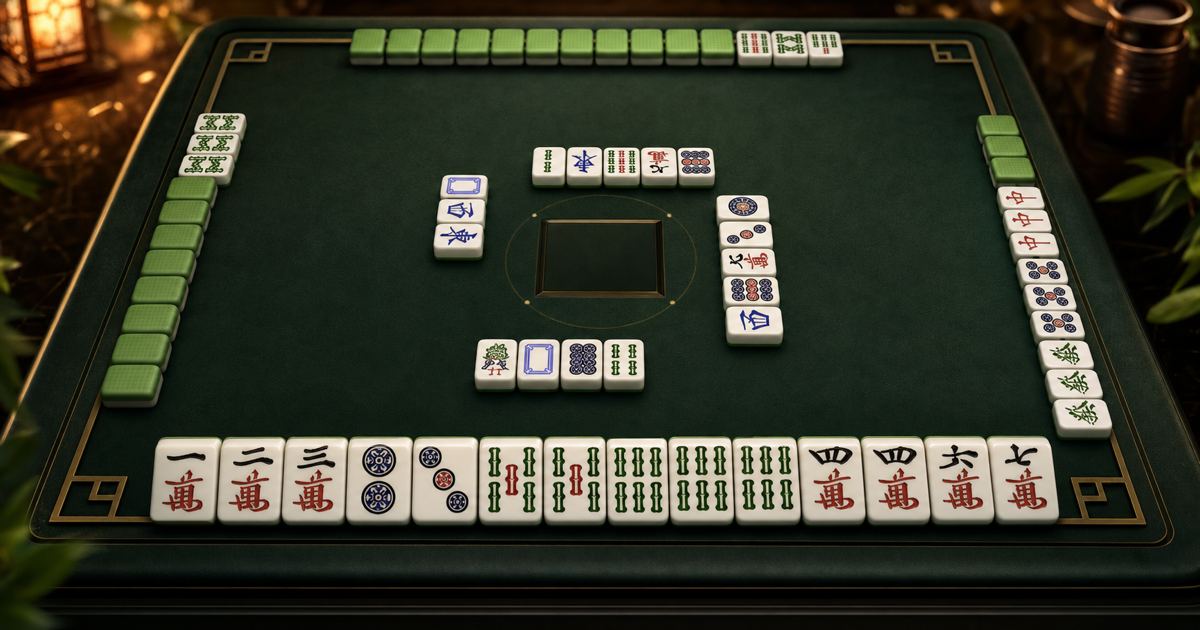
An authoritative beginner reference to Mahjong tile sets: suits, honors, terminals, simples, flowers, and how each family functions during hand construction.
A standard Mahjong set contains 136 core tiles divided into three suited families and two honor families. Each unique tile has four identical copies in the set.
Suited tiles run from 1 to 9 in Dots (Pin), Bamboo (Sou), and Characters (Man). Honor tiles include four Winds (East, South, West, North) and three Dragons (Red, Green, White).
Suited tiles are the workhorses of Mahjong. They can form both three-tile sequences (like 2-3-4) and three-tile triplets (like 5-5-5).
Middle suited tiles (2 through 8), known as simples (Tanyao tiles in Japanese), are the most flexible because they can connect to multiple sequence shapes on either side.
Four copies of each numbered Dot tile (36 total Dots).
Four copies of each Bamboo tile (36 total Bamboo; 1 Bamboo is traditionally a bird).
Four copies of each Character tile (36 total Characters).
Terminals are the 1s and 9s of each suited family. They are less flexible than middle tiles because a 1 can only connect upwards (1-2-3) and a 9 can only connect downwards (7-8-9).
Despite their lower flexibility, terminals play key roles in high-value scoring patterns like Chanta (Terminal and Honor hand), Junchan (Pure Terminals), and Kokushi Musou (Thirteen Orphans).
| Category | Tile Numbers | Key Strategic Role |
|---|---|---|
| Simples (Tanyao) | 2, 3, 4, 5, 6, 7, 8 | Maximum sequence flexibility, safe hand construction |
| Terminals (Routou) | 1 and 9 in all 3 suits | Cornerstone for terminal-based scoring patterns and outside hands |
| Winds (Kazehai) | East, South, West, North | Value scoring when matching seat or prevalent round wind |
| Dragons (Sangenpai) | Red, Green, White | Universal value triplets across almost all Mahjong variants |
Honor tiles cannot form sequences. They can only be used as pairs or triplets.
Dragons (Red, Green, White) provide automatic value triplets in almost every ruleset. Winds provide value when they match your current seat wind or the prevalent round wind.
Four copies of each Wind direction (16 total Wind tiles).
Four copies of each Dragon (12 total Dragon tiles).
Flower and Season tiles are bonus tiles numbered 1 to 4. When drawn, they are immediately set aside, and the player draws a replacement tile from the dead wall or back of the live wall.
Flowers add bonus scoring points in Hong Kong Classic, MCR, Filipino, and Taiwanese Mahjong, but they are omitted in Riichi and Simplified Chinese modes.
The fastest tile-reading improvement comes from function, not terminology. Suited middle tiles are flexible because they can complete more sequence shapes, terminals are powerful when a hand specifically wants them but clumsy when they sit alone, and honors are strongest when they produce value or solid pairs. Once you classify tiles by function, discard decisions become much easier than if you try to memorize every tile as a separate concept.
This is also why strong beginners stop asking whether a tile is good in isolation. A 5 Bamboo can be excellent in an open-ended shape and mediocre when it duplicates an already-cluttered suit. An East Wind can be dead weight or a major value tile depending on the rules and seat context. Good tile reading always asks what role the tile is playing in the current hand plan.
If you want faster beginner progress, prioritize three habits. First, keep connected suited tiles early unless they clearly conflict with a higher-value route. Second, avoid hoarding isolated honors just because they feel special. Third, notice when your hand is becoming overcommitted to too many suits at once. Those three habits prevent most of the messy hand shapes that make new players feel lost.
The point is not to discard every honor and every terminal on sight. The point is to stop giving them automatic importance. Beginners improve when they treat tile selection as evidence-based: what is connected, what is paired, what scores, and what is just taking up space.
| Step | Focus | Why It Helps |
|---|---|---|
| 1 | Learn the three suited families | Sequences drive most beginner hand development |
| 2 | Add winds and dragons | Honors change pair and triplet priorities |
| 3 | Understand terminals vs simples | Many scoring ideas depend on the difference |
| 4 | Review flowers only in HKOS and MCR | They affect replacement draws and value, not ordinary shape |
No. Honor tiles (Winds and Dragons) can only form triplets (Pungs) or pairs (Eyes). They can never form 3-tile sequences (Chows).
No. Flowers depend on the ruleset. They are used in HKOS, MCR, Filipino, and Taiwanese flows in this app, but omitted in Simplified Chinese and standard Riichi modes.
Middle suited tiles connect to more sequence outcomes. A tile like 5 can work with 3-4, 4-6, and 6-7 patterns, while a 1 can only connect on one side. That flexibility is why middle tiles are usually easier for beginners to use well.
Keep them when they already pair, fit a clear scoring route, or matter to the specific ruleset and seat context. If none of those conditions apply, isolated honors are often weaker than connected suited tiles and make clean hand building harder.