 tsumo
tsumoWhat happens if two players call Pon and Chi at the exact same moment?
Pon always takes precedence over Chi. The player declaring Pon takes the tile, exposes their triplet, discards a tile, and play continues from their right.
Understand Mahjong turn order, claim interruptions, discard priority, and why action timing matters for legal calls, winning decisions, and defense.
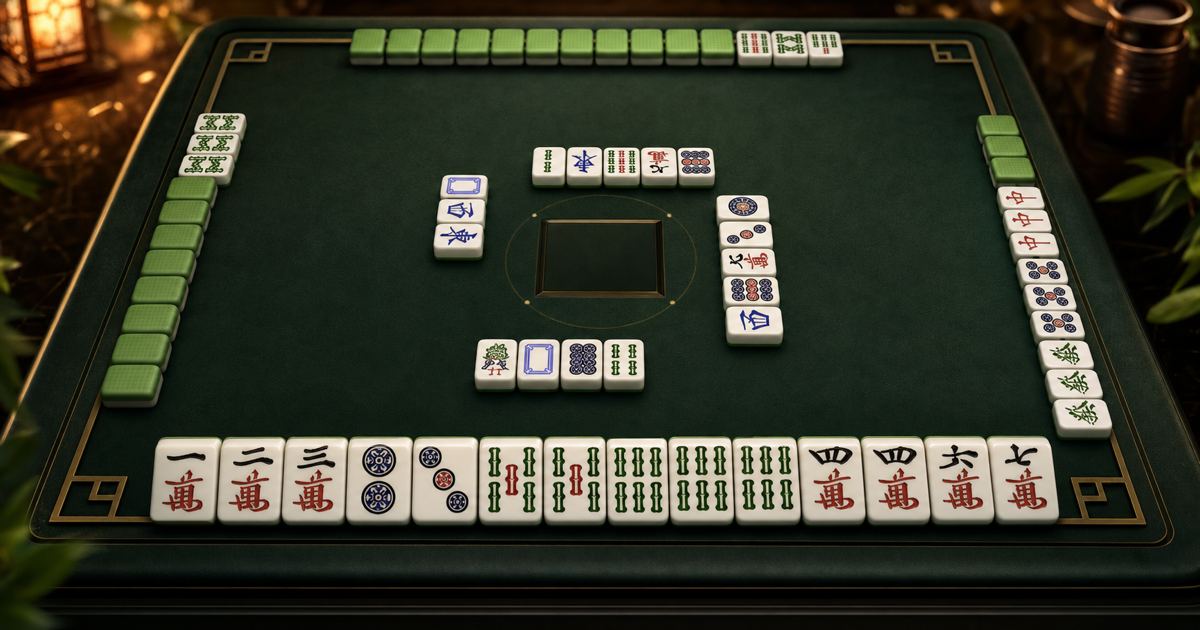
Understand Mahjong turn order, counter-clockwise flow, claim priority hierarchy, simultaneous win resolutions, and dealer rotation rules.
Player turn order in Mahjong strictly proceeds counter-clockwise (East -> South -> West -> North) around the four table seats.
The round begins with the East player (the Dealer). After East draws and discards, play passes to the player to the discarder’s right (South), then West, then North, before returning to East.
When a tile is discarded into the center of the table, multiple players may want to claim it simultaneously. Mahjong resolves conflicting claims using a strict legal hierarchy.
| Priority Level | Declaration Type | Rules & Precedence |
|---|---|---|
| 1 (Highest) | Ron / Hu (Win Claim) | Wins the hand immediately; supersedes all Pon, Kan, and Chi calls. |
| 2 (Medium) | Pon (Triplet) & Kan (Quad) | Beats any Chi claim regardless of who called first; valid from any seat. |
| 3 (Lowest) | Chi (Sequence) | Valid ONLY from the player to the discarder’s immediate right (Kamicha). |
If two (or three) players simultaneously declare Ron on the exact same discard, how the table settles the win depends on the active ruleset.
Head Bump (Atama-hane): Used in traditional Japanese rules. Only the player closest to the discarder in counter-clockwise turn order is awarded the win; the other declarations are nullified.
Double Ron / Multiple Wins: Standard in modern commercial and casual rulesets. Both winning players score their hands and the discarder pays the full amount to each winner.
Dealer retention and rotation govern match progression:
If the Dealer (East) wins the hand or is in Tenpai (ready) during an exhaustive draw, the Dealer retains their seat (Renchan) and a Honba repeat counter is added to the table.
If a non-dealer wins, the Dealership rotates counter-clockwise: South becomes the new East, West becomes South, North becomes West, and the previous East becomes North.
A complete game (Hanchan) typically consists of an East Round (all 4 players get a dealership turn) followed by a South Round.
Consider a common table scenario: Player East discards the 5 of Dots. Player South (to East’s right) calls Chi to complete a sequence. Player West (across from East) calls Pon to complete a triplet. Player North calls Ron to declare a winning hand.
Under the international claim hierarchy: North’s Ron claim takes absolute priority and wins the hand immediately. If North had not called Ron, West’s Pon claim would take precedence over South’s Chi claim, because Pon/Kan always supersedes Chi regardless of who shouted first.
Certain rare occurrences interrupt the standard counter-clockwise turn progression:
Robbing the Kong (Chankan / Qiang Gang): When a player attempts to add a fourth tile to an existing open triplet, an opponent waiting on that tile can declare an immediate winning Ron, intercepting the quad before it resolves.
Exhaustive Draws (Ryuukyoku / Huang Zhuang): When the live wall is reduced to the dead wall reserve (or 0 tiles in Chinese rules) without a winner, the hand ends in a draw, dealer rotation is evaluated, and Honba counters are placed.
| Declaration | Who Can Call | Precedence Level | Next Turn Passes To |
|---|---|---|---|
| Ron (Win Claim) | Any player in Tenpai | 1 (Absolute Top) | Hand concludes immediately; winner collects payout |
| Pon (Triplet Claim) | Any player with matching pair | 2 (High) | The calling player (who discards and continues to their right) |
| Kan (Quad Claim) | Any player with matching triplet | 2 (High) | The calling player (draws replacement tile, then discards) |
| Chi (Sequence Claim) | Player to discarder's left only | 3 (Normal) | The calling player (who discards and continues to their right) |
Pon always takes precedence over Chi. The player declaring Pon takes the tile, exposes their triplet, discards a tile, and play continues from their right.
A Honba counter is a repeat marker placed on the table after a dealer win or exhaustive draw. Each Honba counter adds bonus points (typically 300 points in Riichi) paid to the winner of the next hand.
Atama-hane is the rule where if two players declare Ron on the same discard, only the player sitting closest to the discarder in counter-clockwise turn order is awarded the win.
Turn order jumps directly to the player who made the Pon call. That player discards a tile from their hand, and play then continues with the player sitting to their immediate right, skipping any players in between.