 tsumo
tsumoExposed Sequence (Chi) Claimed from Left Player
Only legal from the player directly to your left in turn order.
Learn how Mahjong sequence, triplet, and quad calls work, how they change turn flow, when each claim is legal, and when passing protects a stronger hand plan.
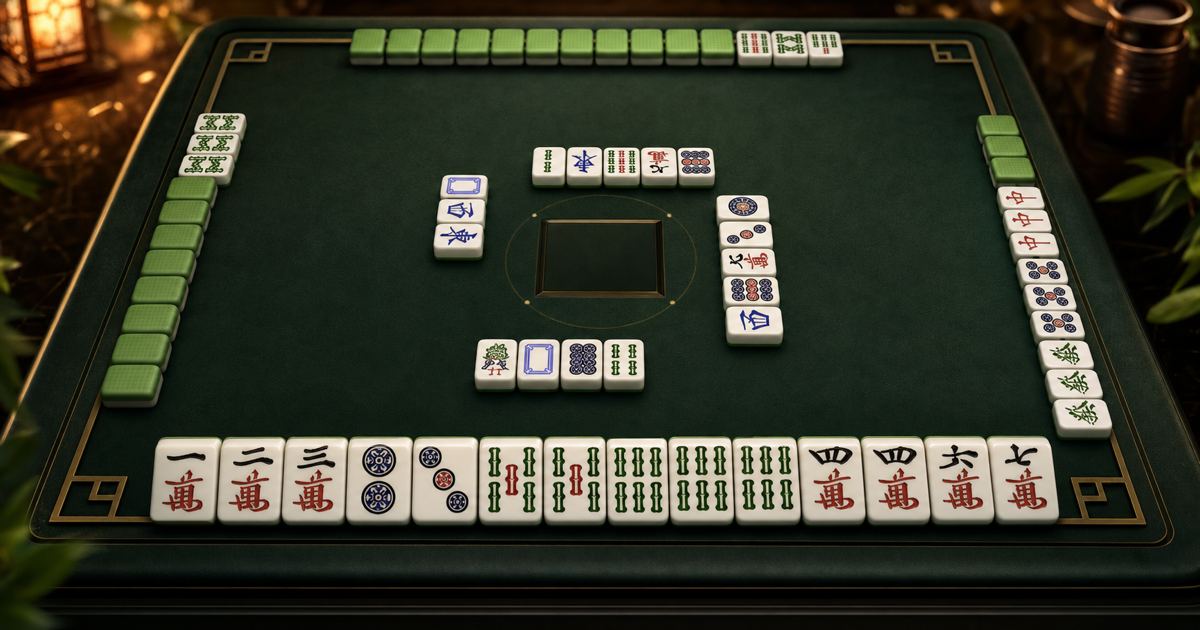
Master Mahjong calls: Chi, Pon, and Kan mechanics, international tile rotation rules, quad strategic liabilities, and when passing protects your win rate.
Mahjong is unique among tile games because you do not have to rely solely on the wall. When an opponent discards a tile you need, you can declare a call to claim it immediately.
Chi (Sequence): Claims a discard to complete a 3-tile suited sequence (e.g. 4-5 claiming 6). Chi can ONLY be claimed from the player sitting to your immediate left (Kamicha).
Pon (Triplet): Claims a discard to complete a 3-of-a-kind (e.g. holding a pair of 7 Bamboos and claiming the 3rd). Pon can be claimed from ANY opponent at the table.
Kan (Quad): Declares a 4-of-a-kind, requiring an immediate replacement draw from the dead wall to preserve the 14-tile hand count.
Only legal from the player directly to your left in turn order.
Legal from any seat at the table; interrupts normal turn flow.
When you call a tile in physical or digital Mahjong, standard tournament etiquette dictates rotating the claimed tile sideways in your exposed meld to show exactly who discarded it.
| Rotated Tile Position | Called From | Seat Relationship |
|---|---|---|
| Leftmost tile turned sideways | Left Player (Kamicha) | The player who acts immediately before you |
| Middle tile turned sideways | Across Player (Toimen) | The player facing you directly across the table |
| Rightmost tile turned sideways | Right Player (Shimocha) | The player who acts immediately after you |
Beginners love declaring Kan because holding four identical tiles feels powerful, but experienced players treat Kan declarations with extreme caution.
In Riichi Mahjong, declaring a Kan immediately reveals a new Dora indicator (and unlocks additional Ura-Dora), giving extra bonus points to all four players at the table—including opponents who may hold higher-value hands.
Furthermore, an added Kan (Shouminkan) can be intercepted and won on by an opponent through Robbing the Kong (Chankan), resulting in an immediate direct-hit loss.
A winning player treats calls as deliberate tactical transactions rather than automatic impulses.
Every call in Mahjong is a trade: you gain immediate speed and shape certainty, but you pay with flexibility, concealed scoring value, and defensive safety.
When your hand is closed, every tile can be discarded freely to defend against an opponent attack. When you call, those melded tiles are permanently fixed face-up on the table—they can never be discarded, reducing your defensive shield for the rest of the round.
Quads (Kan / Kong) come in three distinct technical categories with different rules:
1. Concealed Kan (Ankan): You draw all four matching tiles yourself. Hand remains closed; opponents cannot rob this quad (except Thirteen Orphans in Riichi).
2. Melded Kan (Daiminkan): You hold a concealed triplet and claim an opponent’s discard to form a quad. Hand becomes open.
3. Added Kan (Shouminkan / Kakan): You previously called Pon to form an open triplet, then later draw the 4th matching tile and add it to your open meld. Warning: Opponents CAN declare Ron on this added tile via Robbing the Kong (Chankan)!
| Situation | Default Beginner Action | Strong Player Move | Why It Works |
|---|---|---|---|
| Holding 4-5 suited and opponent discards 6 | Call Chi immediately | Pass and wait for self-draw | Keeps hand closed for Pinfu/Riichi and conceals hand development |
| Holding isolated pair of non-value winds | Call Pon to get a set | Pass and discard the wind | Avoids building an open hand with 0 Yaku / 0 Faan value |
| Opponent is in Riichi and discards your wait | Call if legal | Pass unless it is a winning Ron | Prevents opening your hand into an opponent’s ready trap |
| Holding 3 identical tiles in hand | Declare Kan on autopilot | Pass and keep as triplet | Prevents flipping bonus Dora for opponents and preserves defense |
No. Under standard Mahjong rules, Chi (sequence claims) can only be made from the player to your immediate left (Kamicha). Only Pon (triplets) and Kan (quads) can be claimed from any player.
Pon (triplet) and Kan (quad) claims always outrank Chi (sequence) claims. A winning claim (Ron) outranks all other meld declarations.
Yes! If you perform an Added Kan (adding a drawn 4th tile to an existing open Pon meld), any opponent waiting on that tile can declare Ron via "Robbing the Kong" (Chankan / Qiang Gang).
Yes. As soon as you make any open call (Chi, Pon, or Melded Kan), your hand is classified as an Open Hand (Kuisagari / Open state), disabling closed-only yaku like Pinfu, Riichi, and Menzen Tsumo.