 tsumo
tsumo5-Block Hand Decomposition Example
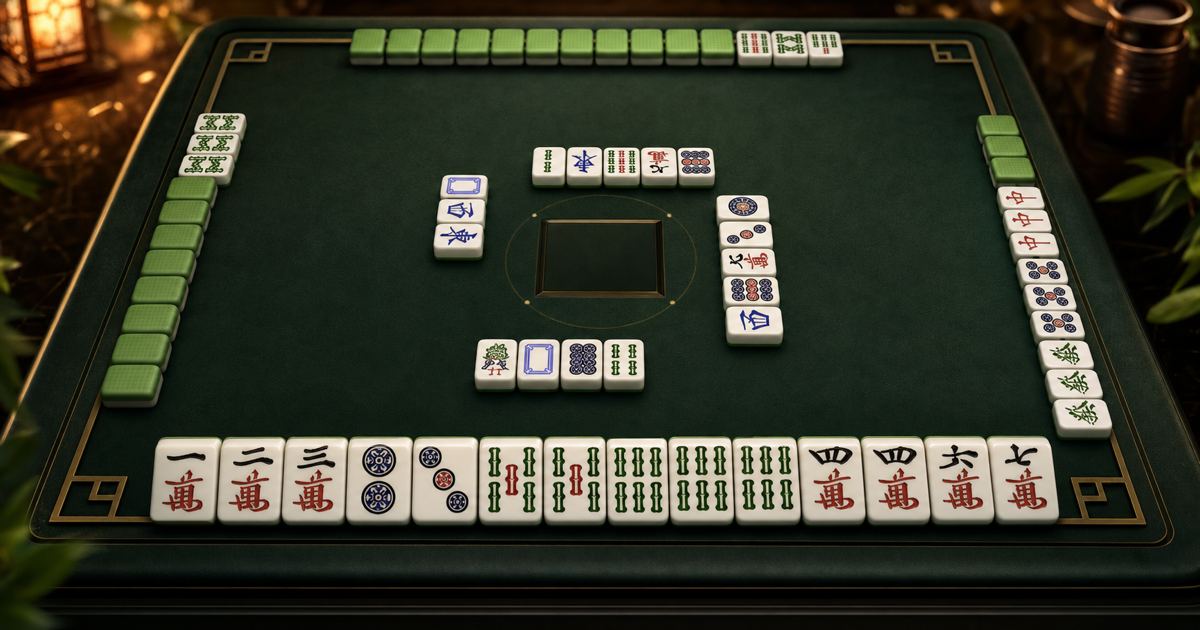
Hand cleanly divided into 5 blocks: 4 prospective set candidates and 1 pair candidate.
A beginner Mahjong strategy guide covering tile efficiency, claim discipline, scoring awareness, basic defense, and how to turn study into better decisions.
Foundational Mahjong strategy: 5-block hand decomposition theory, wait quality hierarchy, river reading defense, and push-fold decision making.
The golden key to Mahjong tile efficiency is 5-Block Theory. On turn one, partition your 13 tiles into five distinct blocks: four set candidates plus one pair candidate.
Once you identify your five strongest blocks, any tile that does not belong to those five blocks is surplus and should be discarded systematically (isolated honors first, then isolated terminals, then isolated middle tiles).
Hand cleanly divided into 5 blocks: 4 prospective set candidates and 1 pair candidate.
Tile efficiency is about choosing shapes that maximize the number of winning tiles remaining in the wall.
| Rank | Wait Category | Example | Wall Outs Remaining |
|---|---|---|---|
| 1 | Two-Sided (Ryanmen) | 4-5 suited | 8 tiles (four 3s and four 6s) |
| 2 | Three-Sided Extended (Sanmenchan) | 2-3-4-5-6 suited | Up to 11 tiles (1s, 4s, 7s) |
| 3 | Dual Pair (Shanpon) | Pair of 3s + Pair of 8s | 4 tiles (two 3s and two 8s) |
| 4 | Closed / Inside (Kanchan) | 2-4 suited | 4 tiles (four 3s) |
| 5 | Edge (Penchan) | 8-9 suited | 4 tiles (four 7s) |
Every tile discarded into the river is public information. By reading the visible discards, you can deduce which suits are heavily contested and which are safe.
If an opponent discards early 4s and 6s, they are unlikely to be building sequences in that suit. If no honors have been discarded by turn 8, an opponent is likely holding a dangerous concealed honor pair or triplet.
Mahjong is a game of risk management. When an opponent declares Riichi or shows a high-value open hand, evaluate your own position:
Push (Attack) if your hand is in Tenpai with high scoring value (e.g. 3+ Han or 4+ Faan) and a good two-sided wait.
Fold (Betaori) if your hand is 2-shanten or low value with an awkward wait. Discard 100% safe tiles (Genbutsu) and let the other players take the risk.
A standard Mahjong round of 18 turns divides into three distinct strategic phases:
Early Game (Turns 1-6 / Shanten Reduction): Focus purely on tile efficiency. Discard isolated honors and terminals, build your 5 blocks, and maximize two-sided connections.
Mid Game (Turns 7-12 / Route Confirmation): Lock in your scoring gate (Yaku, Faan, Points). Decide whether to open your hand with calls or stay closed for Riichi/Pinfu.
Late Game (Turns 13-18 / Defense & Risk Control): Table danger spikes as opponents reach Tenpai. Scan visible discard rivers, avoid dealing dangerous middle tiles, and prepare to fold completely if your hand is not ready.
Suji is the foundational defensive reading technique in Riichi Mahjong based on two-sided sequence waits (Ryanmen).
Because a sequence wait spans three numbers (e.g. 1-4-7, 2-5-8, 3-6-9), if an opponent has discarded a 4, their two-sided waits cannot be 2-3 (waiting on 1-4) or 5-6 (waiting on 4-7) due to Furiten. Therefore, 1 and 7 become relatively safe (Suji safe) against two-sided waits.
| Turn Range | Primary Objective | Key Decision Point |
|---|---|---|
| Turns 1–6 (Early) | Discard isolated dead tiles; identify 5 blocks | Keep flexible suited pairs over isolated honors |
| Turns 7–12 (Mid) | Advance to 1-shanten; secure value anchor | Evaluate open call opportunities vs closed hand value |
| Turns 13–18 (Late) | Reach Tenpai or fold safely (Betaori) | Compare your hand value against opponent threat level |
5-Block Theory is the foundational hand-building method where you structure your 13 tiles into 5 discrete units (4 prospective sets and 1 pair). Any 6th extra block or isolated tile is discarded to streamline hand speed.
Push if your hand is in Tenpai with high value and a strong wait. Fold if your hand is far from ready (1-2 shanten), low value, or has a narrow wait shape.
Suji is a defensive discard deduction method based on the 1-4-7, 2-5-8, and 3-6-9 sequence wait patterns. If a middle tile (like 4) has been discarded by an opponent, the corresponding edge tiles (1 and 7) become safer to discard against their two-sided waits.
Betaori means total defensive folding. When an opponent poses a serious win threat and your own hand is slow or low-value, you give up on winning and exclusively discard 100% safe tiles (Genbutsu) to avoid dealing into their win.