 tsumo
tsumoMCR Mixed Straight (8 Points Qualification)
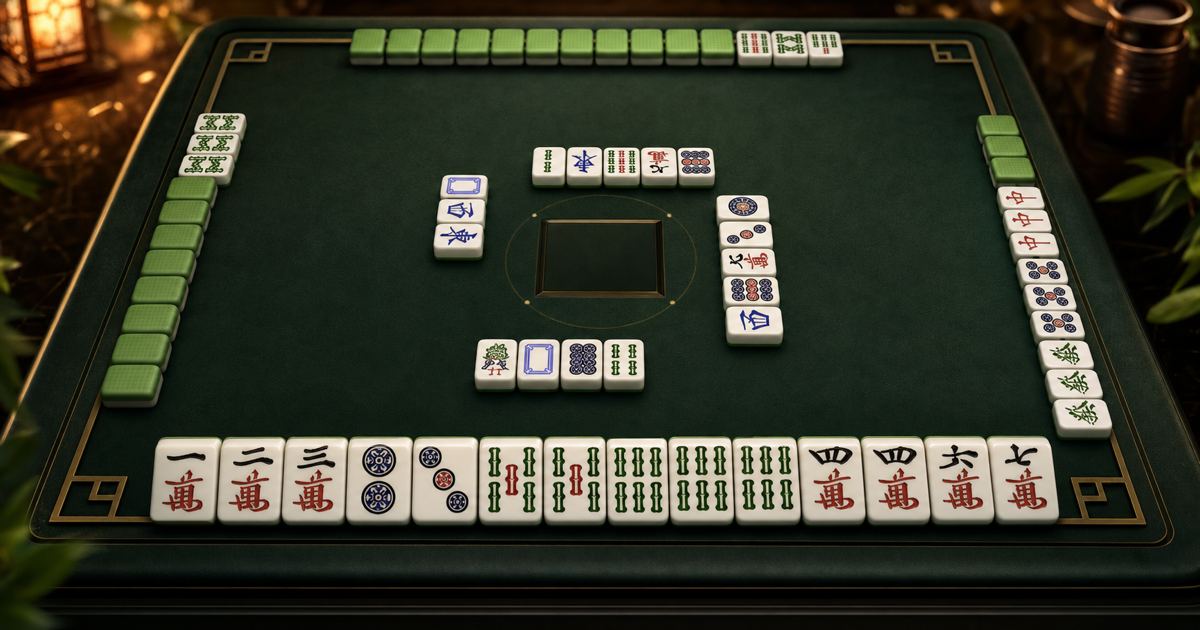
Mixed Straight (8 pts) across Dots, Bamboo, and Characters satisfies MCR gate.
Compare Riichi and MCR Mahjong by yaku, scoring routes, point gates, defensive pressure, pattern difficulty, and which variant is better to learn next.
Compare Japanese Riichi and Mahjong Competition Rules (MCR): 8-point gate vs single yaku, pattern planning, open-hand calling freedom, and table economy.
Japanese Riichi and MCR (Mahjong Competition Rules / Guobiao) are the world’s two dominant competitive Mahjong codes, but they test different cognitive skills.
Riichi rewards defensive awareness, risk management, and tactical timing. A player can win with a modest 1-Han Yaku (like Tanyao or Riichi) and rely on Dora or Riichi bets to multiply value.
MCR rewards expansive pattern planning and arithmetic mastery. Every hand must assemble at least 8 points from 81 standardized scoring patterns, encouraging creative combinations across all three suits.
| Feature | Japanese Riichi | MCR (Competition Rules) |
|---|---|---|
| Legality Threshold | At least 1 valid Yaku | At least 8 non-flower Points |
| Open Hand Freedom | Restricted: Calling reduces or eliminates many Yaku | High: Most 8-point patterns allow open calling without penalty |
| Defensive Rules | Furiten, Genbutsu safe tiles, Riichi defense | No Furiten; full table play throughout the round |
| Table Bets & Counters | Riichi sticks (1,000 pts) and Honba repeat counters | Flat point payments (8 base points + differential) |
| Pattern Library | Approx. 40 Yaku | 81 distinct official scoring patterns |
In MCR, an expert player evaluates the opening 13 tiles to identify overlapping pattern clusters—such as Mixed Shifted Chows, Pure Straights, or Tile Combinations—and plans an exact 8-point route from turn one.
In Riichi, players prioritize 5-block efficiency and speed, keeping their hand closed to preserve the option to declare Riichi or pivot into full defense if an opponent attacks first.
Mixed Straight (8 pts) across Dots, Bamboo, and Characters satisfies MCR gate.
A major mechanical difference lies in how extra hand value is generated.
In Riichi Mahjong, the Dora indicator tile revealed at the start of each round adds a layer of dynamic risk: any matching Dora in your hand adds +1 Han multiplier, and winning after Riichi unlocks hidden Ura-Dora. This allows a quick 1-Han hand to explode into high-value Mangan or Haneman scores.
In MCR, there are zero random multipliers. Every single point on your score sheet must be earned through deliberate, deterministic tile arrangement across the 81 recognized patterns. This makes MCR scoring an exercise in pure combinatorial skill.
If you enjoy the psychological tension of poker, discard deduction, and push-fold risk management, learn Riichi.
If you enjoy mathematical pattern assembly, rich multi-suit combinations, and aggressive calling freedom, learn MCR.
In MCR, starting tile assessment is about combinatorial pathfinding. You inspect your opening hand and identify potential 8-point routes across multiple suits: Pure Shifted Chows, Mixed Triple Chow, or All Chows plus Simples.
In Riichi, hand assessment is about speed, value potential, and safety. You evaluate whether your hand can reach closed Tenpai quickly for Riichi, whether you have a simple Tanyao or Yakuhai path, and how many safe tiles you hold in reserve.
In Riichi, calling a tile to open your hand carries severe penalties: it permanently disables Riichi, Pinfu, and Menzen Tsumo, and reduces the Han value of hands like Honitsu (from 3 Han to 2 Han) and Sanshoku (from 2 Han to 1 Han).
In MCR, most 8-point patterns (such as Mixed Triple Chow, Mixed Straight, and Pure Shifted Chows) suffer NO open-hand penalty—they award the exact same full 8 points whether open or closed. This makes calling in MCR an offensive tool with zero value degradation.
| Dimension | Japanese Riichi | MCR (Guobiao) |
|---|---|---|
| Qualifying Gate | Single Yaku (1 Han min) | 8 Points (from 81 patterns) |
| Open Call Penalty | Heavy: destroys/reduces Han on many Yaku | Minimal: most patterns award full points open |
| Defensive Depth | Extreme: Furiten, Genbutsu, Suji defense | Moderate: no Furiten, active racing |
| Tournament Focus | Risk management, dealer defense, point efficiency | Pattern assembly, math precision, multi-suit play |
Many concepts overlap (like All Simples, Half Flush, and All Triplets), but MCR values them differently and requires an 8-point sum rather than a single qualifying Yaku.
MCR is designed around pattern competition and active hand building rather than total defensive folding. Without Furiten, players remain active in the race throughout the hand.
MCR patterns are defined by their combinatorial difficulty rather than concealed status. Since building multi-suit patterns like Mixed Triple Chow is already challenging, MCR allows players to call freely without point deductions.
MCR has 81 distinct scoring patterns to remember, while Riichi has Han/Fu exponential arithmetic. Once you learn the top 5 starter 8-point combinations, MCR scoring becomes straightforward addition.